

Some directors are very natural auteurs. Their films always seemingly a product of their own conception which seems unavoidable to visually mistake. Viewing all of Andrei Tarkovsky’s films, this is perhaps clearer to see than in the case of most other directors. His distinctive visual style, which morphs into several similar variations, is instantly recognisable. Dripping with faded lights, distinct textures and elemental forces, his films become a collection of photographed memories with different tones, yet mostly shot through the same prism of ideas.
Tarkovsky’s style invades all of his work within other media, too. It is very clear from his writing style that the same elemental forces of interest and aesthetic approaches are being adhered too; the physical embodiment and malleability of time, the forces of wind, water and fire, the poetry of decaying architecture and civilisations. Even in his interviews, the words he speaks seem to carry this same collection of principles; they are words that, if applied to a visual form, would look exactly the same as the actual cinema the director created.
It seems fitting then with this talk of a visual nature behind non-visual actions, that Tarkovsky was also a prolific photographer. The man captured his personal life in many pictures, slowing time down to a mere twenty-fourth of a second. Even with this, his visual habits are recognisable, so much so that it seems absurd, almost crass to point it out. That is, however, what this article is about.
So many of Tarkovsky’s pictures capture that same distanced mysticism and nostalgia with such success that a number of the them are fairly easy to link to several of his films. The most obvious of these are his pictures of dogs. There are a number of readings of the presence of the dog in both Stalker (1979) and Nostalghia (1983). However, the connection that seems most fitting with his Polaroids is between the characters of the films and Tarkovsky himself. The dogs’ presence can seem to symbolise the presence of the director, like a calling card or simply a gentle nod. In the Polaroids, this is clearer as the presence of the dog in front of camera implies the presence of Tarkovsky behind the camera.
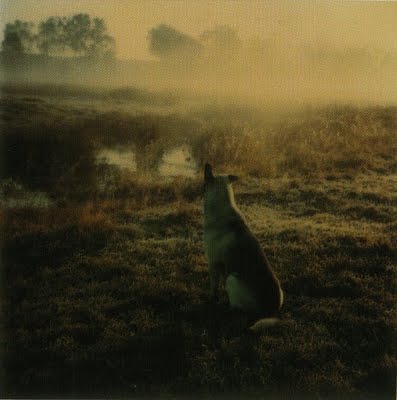

Tarkovsky also has a special skill in capturing photographs of places at certain times of the day meaning that they often resemble The Zone from Stalker. Dawn and dusk were his most active photographic times. The Polaroid of the dog with the mist quietly falling upon the ground is a very natural expansion of Stalker’s world, at least in an obvious visual sense. Stalker in particular seems relevant to many of the landscape Polaroids simply because of the natural light. This light often brings out the greens and faded turquoise; almost to the point where they seem metallic. Once out of the totalitarian, sepia world, The Zone embodied this faded world with the distant ghost of human activity felt through the presence of broken buildings. The Polaroids exhibit the same atmosphere.

The implication of the presence people through showing their explicit upheaval is something Tarkovsky has continually returned to in his films. The idea forms itself directly into the narrative of Solaris (1972) while being visually hinted at in the likes of Andrei Rublev (1966), The Mirror (1975) and The Sacrifice (1986). This theme also makes it into Tarkovsky’s Polaroids, several of which show loss through implication. The most famous of these is a beautifully coloured shot of a table. The table has flowers on and is set with a meal and dishes. There is, however, no one there. The shot has that haunting Tarkovsky quality that hints at something unreal manifesting through the consciousness of a person in exactly the same way that the man recreates his dead wife thanks to the strange powers of planet of Solaris. Is this a precious memory regained?

Light invades even the darkest of spaces of these Polaroids, shining patches onto beds and corridors, empty chairs and vases. They seem closed and yet infinite much like the readings of Tarkovsky’s films. The clash between the captured nature of time in the pictures and the “sculpting” of time in his films is surprisingly non-existent. Many of the photos balance naturalism with the heightened beauty of Tarkovsky’s stylised world and act as an extension of his films (especially Nostalgia and The Sacrifice, which were filmed when many of the photos were taken).
The other main theme to enter into Tarkovsky’s Polaroids is one that is very natural; that of familial memory. Like the snapshots taken by any family, his photos often hold personal moments frozen in time with various relatives. A number of pictures of women resemble of segments of his film Mirror. They have a motherly fondness to them even when they are not actually maternal. These women are often captured in a moment of natural awareness; acting normally but somehow knowingly at the same time. These pictures display fragments of a life, perhaps even a narrative that has never been truly told. This is something extremely Tarkovsky-esque with the director often finding more to say about the things that are not shown plainly or obviously.


There is a sense of raw beauty in Tarkovsky’s Polaroids, proving that great ideas can transcend whatever medium they decide to fall into. Like his films, the photos present a number of thematic and aesthetic ideas though these are not sculptures in time; they are mementos and sketches. It is fitting then that these photos are Tarkovsky’s world in a microcosm; questioning, subtle and somehow cinematic.

 Celluloid Wicker Man
Pretty sure you meant ‘maternal’.
I did indeed. Thank you for alerting. Changes are now made.