

I thought it would last my time –
The sense that, beyond the town,
There would always be fields and farms,
Where the village louts could climb
Such trees as were not cut down;
I knew there’d be false alarms
– Going, Going, Philip Larkin.
Above is the opening stanza of Philip Larkin’s 1972 poem, Going, Going. The poem captures the sense of a world being lost. The poem is deeply concerned with the loss of something very particular but also about awareness, even powerlessness, of this loss as it happens slowly.
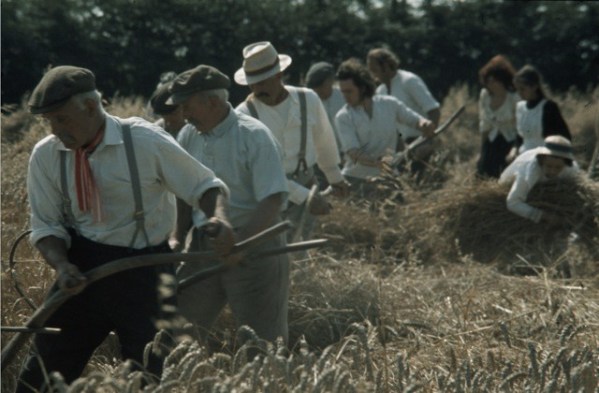
Four years after Larkin published Going, Going, filmmaker David Gladwell made the first of his two feature films, Requiem for a Village (1974), which is one of the few British film of the same period to channel Larkin’s sense of loss and frustration.
What was being lost to both Larkin and Gladwell was the isolation of the English village and, in the era of the 1970s, this was a steady but constant evolution that had been happening since the end of the Second World War: the threat of the bulldozers and the Brutalist New Towns concerned both artists.
Neither artist is gripped by nostalgia for some golden age of innocence but instead are on the straightforward attack; condemning the replacement of small-scale community with the dramatic increase of housing, roads and general interconnectivity with a vastly increasing population.
The inevitability of this conclusion means that both the poem and the film have an air of melancholy in their representations of rural life, as well as a sense of extremity when depicting the oncoming presence of suburban and urban dwellers.
And that will be England gone,
The shadows, the meadows, the lanes,
The guildhalls, the carved choirs.
There’ll be books; it will linger on
In galleries; but all that remains
For us will be concrete and tyres.
Larkin seems more concerned with the encroachment of concrete in particular upon his beloved villages, whereas Gladwell is more interested in building a collection images to show both types of places before their clashing. For Gladwell, there is an ironic likeness between the people from each landscape.
On saying this, however, Gladwell does present the coming of suburbia as being a powerful enough threat to literally waken the dead; the deceased villagers rising out of their graves, a la Stanley Spencer. They are, however, rising to attend a worried town meeting rather than due to some transcendent calling. Compare this scene (the film’s most famous and visually stunning moment) with the several segments from Going, Going, and Larkin could be seen quite easily as one of Gladwell’s disgruntled villagers.
For Gladwell, Larkin’s tragedy has already happened. The meeting of the people in the town seems deeply ironic as motorcycle gangs terrorise the area. The threat has already arrived, but their actions were already mimicked by local rural people anyway (specifically violence and sexual assault). Gladwell’s vision refuses the uniquely positive vision conjured by Larkin.
Requiem for a Village becomes one of the artefacts that Larkin talks about in his poem, a reminder that a certain breed of English life ‘will linger on’ but only within artwork and ‘in galleries’ though hardly even there anymore; Spencer’s paintings have long since been problematised by ineffectual cowards.
As Going, Going progresses, Larkin’s seething rage builds to the point where it clouds his vision with a pessimism that becomes almost sardonic. Clearly the new development of the landscape had a stark effect on the aging poet who seemed to be at the epicentre of an evolving and changing topography (though in reality he was not).
The closest Gladwell comes to sharing this anger is in the portrayal of the motorbike gang; a common occurrence as a rebellious symbol in cinema post Easy Rider (1969). Interestingly, it is the ease between the estates where they come from and the village in question that Gladwell seems to question. Roads are Gladwell’s real enemy, and he has a morbid fascination with them.
Compare this to a pulp film such as Don Sharp’s Psychomania (1973) and the difference becomes clear. While the portrayal and actions of bikers entering rural locales is very similar in both films, the key difference is that the bikers in the pulp film search out a rural locale as a sanctuary from the stuffy confines of a 1970s urban environment (they choose a stone circle over newly Brutalist Henley-on-Thames, understandably) but often release their frustration upon their fellow urban dwellers when back in the concrete streets.
In Requiem for a Village, the bikers also seem to search out a rural plateau to escape bland suburbia but release their inhibitions within the rural environment; where the rules seem intangible and the isolated fields, meadows and country lanes are open ground for their carnal desires.
While Going, Going and Requiem for a Village channel very similar ideas and themes, one final key difference is worth noting between the two works. Larkin’s poem was one of the last he would write, predicting a future that was yet to fully finalise (it is telling that the poem’s title implies an unrealised ‘gone’; Larkin’s prediction had yet to come true).
Gladwell, on the other hand, sees rural life in the past tense, It is something to question and cherish in the memory. The position of tense is the key difference between the works, and while both reflect a strange moment in 1970s British culture, they summarise a surreal supposition of how landscape should conform; one that never really existed in quite the way they mourn but one still worth remembering all the same.
 Celluloid Wicker Man
3 thoughts on “Philip Larkin’s Spirit in Requiem For A Village (1976)”