
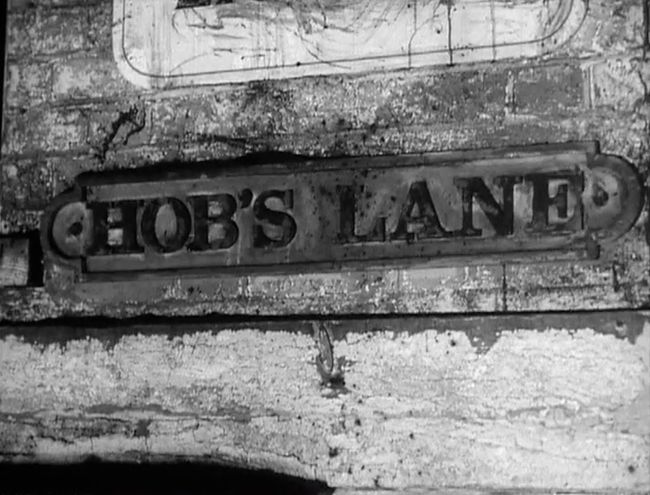
One of the key criticisms of theories surrounding the genre Folk Horror is its emphasis upon the rural landscape. How can a genre really encompass such rural horror films as Witchfinder General (1968) and The Wicker Man (1973) while also discussing more urban-set horrors such as Quatermass and the Pit (1967)?
While key works of Folk Horror cinema seem to broadly focus on rural landscapes to set and conjure their horror within them, by setting up such a rigid parameter for defining films in the genre it does indeed neglect some of the most popular and effective examples. This brief assessment aims to balance the rural emphasis with some of the more urban of examples, labelling them Urban Wyrd, and showing their links to their rural cousins, as well as several key differences.
When putting together a presentation about Folk Horror for a conference in Belfast last year, some of the preparation for it was to try and anticipate criticisms and potential questions that would be asked afterwards. The key question that I really feared at the time was a relatively straightforward one and went something along the lines of ‘What about Quatermass And The Pit?’
A question about Nigel Kneale’s drama would have produced a unforgivably long silence on my part at the time as there was simply no answer. My ideas surrounding Folk Horror were uniquely based on the idea that the rural landscape isolates individuals and communities, and their narratives functioned in various directions from this initial premise.
In any of its variations, whether the 1958 BBC television version or Hammer’s adaptation by Roy Ward Baker, Nigel Kneale’s story simply did not fit in with the strictness of any reasoning put forward at the time about Folk Horror. We have come a long way since then, with the genre now an effective little cottage industry for the more pedestrian end of academic writing.
The 1967 Hammer version of Quatermass did not have any skewed belief systems in parallel with, say, that of Summerisle or medieval England. If anything, such beliefs function instead as a race memory lying dormant in all of humanity; the demonic alien insects uncovered during the development of a London tube station having influenced humanity’s more violent and tribal impulses.
In total opposition to other films discussed, it did not have a rural setting either and was firmly placed in a built-up part of London, albeit a largely studio-based recreation (with only a few shots around central London and Chiswick). While the story definitely had a manifestation of some form due to some ancient, hidden power, another common trait of Folk Horror films, the relationship between its summoning and the previous levels of drama were complex and not simply ritualistic. In other words, Quatermass and the Pit was an enjoyable but at the same time, frustrating spanner in the works.
Or was it?
For some time now, my ideas of the chain of Folk Horror, an idea where landscapes lead to isolation of communities, paving the way for skewed morality and eventually summoning and violence, have been critiqued, dismissed and used in a variety of ways (perhaps arguably too much). Yet this example in particular was demanding a reappraisal of several of its idea well before the cottage industry of Folk Horror took off.
In many ways, the way to rethink it was to effectively work backwards, if only because Kneale’s play does at least have the typical Folk Horror outcome; where the Martian alien, responsible for the majority of our religion, folklore and fascism manifests over London to enact a human cull for the survival of the species. This was the desired outcome but what was the dramatic pathway that led to it?
The summoning of this creature was inherent within us as a race memory but also embedded within human curiosity. Perhaps curiosity can be fed further into the idea of skewed belief systems in that, like a lot of horror, a complete lack of awareness towards potentially dangerous or unnerving elements is itself a form of skewed belief system. It certainly does not relate to the reality of being confronted with danger. M.R. James especially would make great use of this human fallacy in a huge number of his stories: a warning to the curious indeed.
In order for the chain to work in more traditional Folk Horror, the landscape must lead to isolation, on screen or off. The initial problem with applying the chain to Quatermass was that the sort of isolation required for Folk Horror seemed theoretically impossible for a film set in central London. After re-watching the film and the television version, as well reading several works on Kneale himself, it seems that the answer is relatively straightforward.
The urban geography of Quatermass is very distinct and specific. In one of Kim Newman’s various analyses of the film (mentioned in most detail within his BFI book on the film), he suggests that Quatermass and the Pit is more claustrophobic than the other Quatermass films. Indeed, Quatermass and the Pit is one of the most isolated and claustrophobic portrayals of London ever put onto film.
London in the film is just as isolating as Summerisle; an effect achieved by a closed-in set that renders a busy street in London as somewhere oppressive and self-contained. It may as well be surrounded by water or miles of empty farmland. The idea of urban geography creating of sense of isolated claustrophobia is very much a trait within several films on the outer periphery of Folk Horror, especially those obstinate ‘Why are they Folk Horror?’ films. The most obvious example is Quatermass because it often crops up within the most basic of Folk Horror discussions. Others, however, are perhaps just as deserving as being part of the discussion of the sub-genre.
The most interesting film that springs to mind is Death Line (aka Raw Meat) (1973). An underrated shocker by Gary Sherman, the film follows the abduction of several people on the London Underground (again linking thematically with Quatermass). These abductions are carried out by a rapidly diminishing group of underground, sub-human cannibals; workers from the building the tube who were left down there and forgotten about.
While no supernatural elements occur, the various outcomes of violent cannibalism and horror still seem very folkloric; as if the narrative could be something a youngster would be told in order to stop them misbehaving on the tube. Survival also seems essential to the urban variation of the chain. Disturbingly, there is little difference between the inhabitants of Summerisle burning a man to help their crops grow with a regressed human kidnapping people to eat from Russell Square. Both scenarios seem utterly necessary to the individuals involved for their survival, once the moral systems of the people have been skewed enough by their respective social isolation.
There could be a huge backlog of films discussed once this idea is opened out. However, several films that could fit into this idea are most definitely not Folk Horror. Alfred Hitchcock’s Rope (1948) is a great example of Urban Wyrd yet is most definitely not Folk Horror. The characters are entirely isolated within their San Francisco apartment, their morality utterly skewed, their actions derived from some sadistic Übermensch ritual with the outcome being their own supposed confirmation of superiority over their social peers. Even Hitchcock’s Frenzy (1972) seems built on these elements though it is merely a digression (along with Michael Powell’s Peeping Tom (1960), Hickox’s Theatre of Blood (1973) and a variety of others).
The point in question is that these other films are not Folk Horror, but the theorizing can draw a parallel line with the genre that can help with exploring and discussing the more anomalous, difficult films that crop up.
By aligning Quatermass and the Pit and others within this parallel framing, strands within Folk Horror become far more tangible, as well as overarching themes of British counter-culture horror as a whole. The city is as weird as the fens and the fields.
Folklore haunts urbanity with equal aplomb.

 Celluloid Wicker Man
Reblogged this on Folk Horror Revival.