
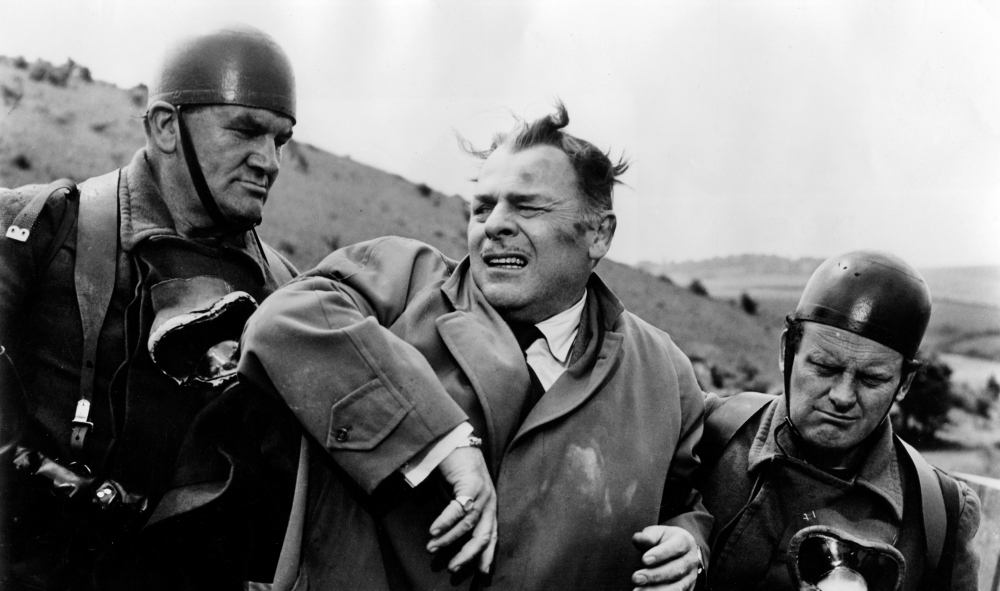
The characters of Nigel Kneale’s work rarely like an outsider. The drama of his plays is often built around small groups of people at odds with some concept of an outsider. The oppositional group will be diametrically opposed for a variety of reasons; sometimes for more pulp tendencies such as aliens in a space invasion scenario, but also more recognisable images of townspeople entering closed rural communities.
The electronics research group in The Stone Tape (1972), for example, envisage an unseen enemy in the form of their Japanese competitors, while a town vet in the episode of the series Against the Crowd, Murrain (1975), is treated with disdain for disbelieving local superstitions about a supposed witch putting a curse upon cattle. Not only do these beliefs build up tension within Kneale’s dramas, they show strong links to the landscape in which the stories are set.
The best example of Kneale’s narrative device, however, is to be found in the various adaptations of Quatermass II, made by the BBC in 1955 and later into a film by Hammer Studios in 1957.
Kneale’s tendency for such a device can be explained by a number of elements, but the most obvious and predominant one is the political climate in which he was writing. His general themes stem from the emphasised island mentality brought about due to the Second World War; a time when the outsider was necessary to demonise if only for more general propaganda (think of Alberto Cavalcanti’s Went The Day Well? from 1942).
This type of thinking is at its strongest in times of conflict and post-conflict, and is an extension of ‘narrow nationalism’ as Anthony Giddens suggested once in a column for the Guardian. Add to this the paranoia over the increasingly volatile state of the Cold War and the Knealian formula seems an expression of the mentality for the entire United Kingdom in the 1950s.
Kneale himself said as much in the introduction to the script published in the 1979. ‘It was 1955,’ he recalled, ‘an uncomfortable time. There was much public concern about a new brand of bureaucracy, which manifested itself in the form of secret establishments: giant radars reputed to endanger human life and concealed huge plastic pods; germ warfare establishments behind barbed wire; atom-proof shelters for chosen administrators.’
Quatermass II fits this model well as it showcases a range of different effects of the supposed outsider which predominantly augment the state of the English landscape. It must also be remembered that Quatermass as a character (at least in the television adaptation) is himself an outsider after the scientific and moral failures of his own experiments in the previous instalment, The Quatermass Experiment (1953). Perhaps the lack of support for the character from various officials throughout the narrative is due to this position but it does seem rather ironic. As Kneale wrote, ‘Quatermass himself would be the lone figure, doggedly worrying his way through officialdom’s barriers and pat explanations to get to the horrifying truth.’
Quatermass II is concerned with the fate of Winnerden Flats, a rural community that has been flattened and modernised to make way for a suspicious food production plant which turns out to be harbouring a special environment for an alien creature. This location presents a number of problems for Kneale in regards to the outsider and the landscape.
In spite of much intrigue occurring in government and at Quatermass’ own rocket research laboratory, the real drama occurs when Kneale moves the narrative to the desolated plains of the rural community as it gives him the opportunity to use the concept of the outsider as a boost of tension (even when the outsider is the drama’s main protagonist).
In typical Kneale-esque fashion, the fear of outsiders from the city is proven to be fallible; they have the means to uncover the uncomfortable truth about the project that the locals have been blindly working on. In a twist of sardonic wit from Kneale, the close-knit rural community of the village are themselves harbouring an outsider, only an aggressive one from space, a creature that intends to colonise the entire planet once it has grown.
In his viewing notes for the plays, Andrew Pixley highlighted the mindset that Kneale felt was becoming the norm in society because of this blind and unquestioning nature. ‘At the time,’ Pixley believes, ‘Kneale was very concerned that people took too much on trust from the authorities. Grasping the sense of paranoia about new, potentially dangerous scientific establishments, he wrote of what could happen if an apparently beneficial advancement or research site was in fact in the hands of the enemies.’ The main aspect to point out from all of this is that outsiders change (or at least want to change) the environment to suit their own needs for the worst. Yet ironically, only another outside is in the position to point this out.
The outsider, in both the context of people from the city and the creature from out-of-space, has destroyed the local environment and placed guards around its newly occupied area. It is not hard to draw comparisons with both the evolution of the Bloc States and the increasing state of paranoia over nuclear war; the people outside your community have the power to not only adapt your environment for their own needs but also have the ability to completely destroy the landscape if they wish. It is the ultimate expression national state paranoia, and no one did it better than Kneale, other than perhaps George Orwell.
Kneale would move in the complete opposite direction for his next instalment of Quatermass. In Quatermass and the Pit, Kneale would conclude that evil was here before humanity rather than from somewhere outside, going so far as to suggest we were all aliens, all outsiders. This may change may have been due to the world revolving around him but there is little doubt that Kneale channelled a great, national paranoia into his work, especially because the very essence of the land was so increasingly scarred by the new wire fences and inhuman architecture that we still arguably take for granted today.
 Celluloid Wicker Man