

At the recent Alchemical Landscape conference in Cambridge, there was some interesting discussion of the landscape seen in the opening segment of Alan Clarke and David Rudkin’s Play for Today episode, Penda’s Fen (1974).
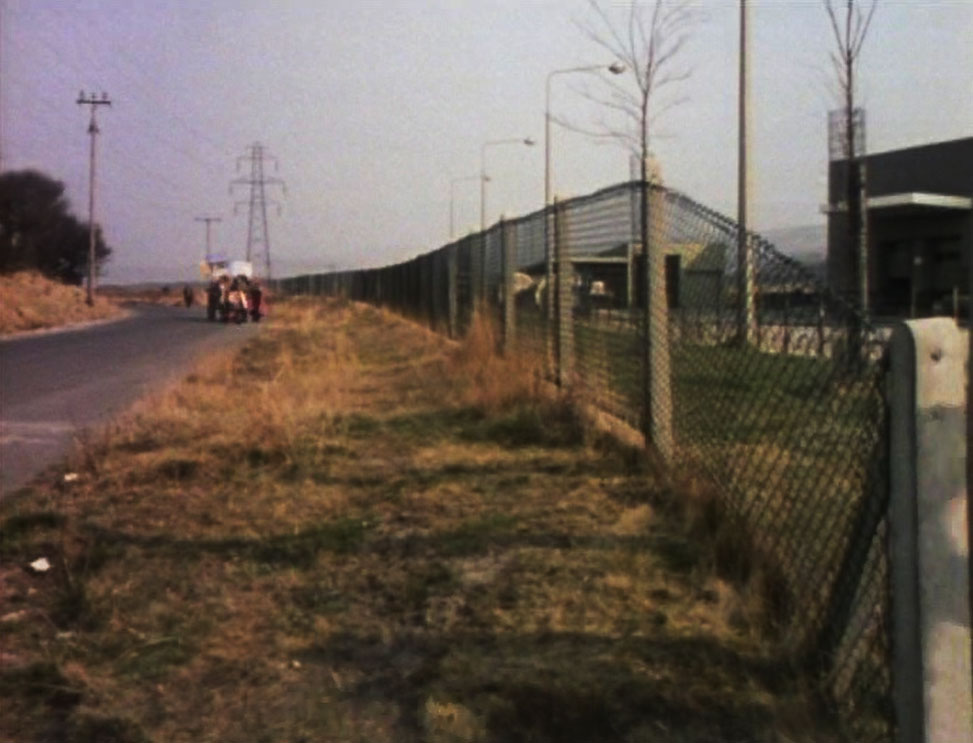
The point of the discussion was to show the subversive nature of the opening titles of the film in regards to its melding of two potentially differing realities of English landscape. On the one hand, the typical pastoral qualities of the Malvern Hills; on the other an encroaching urban experimentation represented by wire mesh fences and a scarred, injured hand.
Though the general consensus of the two landscapes representing a binary was correct in regards to the world of Clarke’s film, as well as the reasoning behind Rudkin’s imbuing the landscape with such a binary in the first place, I began to question whether it actually reflected the genuine reality of the English landscape. On closer reflection, I found it to be too simplistic to transplant such a binary onto the reality of everyday landscapes, and I sought to understand why I thought this.
When watching Penda’s Fen again recently, it was only the hand itself in the opening segment which seemed to hint at a binary of landscape; where there was a manmade danger festering in the fenland of Pinvin. The hand is scarred and clearly injured; perhaps the hand of the man killed by unknown technological forces of the narrative. But other than that, I liked this landscape, wire and all.
The aesthetic of mesh wire over a much greener natural landscape not only seemed perfectly normal to me but also naturally beautiful; this was not some privileged position of venturing into complicated landscapes and not having to deal with the realities of their possible ugliness, but an acceptance that the vast majority of landscapes I have been surrounded by have been filtered by wire and mesh fences.
There is no clash for me between the two as this is how landscape has so often been packaged and experienced. Rarely has there been one of a pure rural or urban binary, even when venturing on holidays to cities such as London or Bilbao or rural retreats to Norfolk, Suffolk and Dorset.
Pondering why this seemed normal and not strictly subversive personally (though it no doubt is in the wider, post-nature writing boom we are currently in, where Romantic Pastoralism has been repackaged via Cath Kidston-level twee by quota hungry agents and publishers using naïve writers to bolster their sales figures), it seemed to draw back to two things: where I come from and what I watched when younger.
It feels doubly poignant a point that Clarke came from Wallasey: where I am from and a place littered with probably more wire fences than actual landscapes. The Wirral’s own blurred binaries between the urban and the rural means that it seems topographically schizoid, filled with wire, edgelands and rural zones, all of course variously fenced off. The vision of Clarke’s landscape in the film is totally normal for someone growing up surrounded by wire mesh fences.
However, more importantly are my first encounters with landscape in the television series Doctor Who (1963-1989). The sheer pleasure of such wire and grass landscape comes from numerous episodes rendering such places fantastical to my child’s vision of the world.
The series is replete with a huge range of edgeland spaces that, unsurprisingly, I ended up reimagining upon The Wirral landscape with ease. Penda’s Fen‘s wire and grass was a deliberate contrast; Doctor Who‘s, by comparison, was accidental and joyfully so.
The first instance I can recall came in the Jon Pertwee story The Green Death broadcast in 1973. It tells of an oil company secretly polluting a Welsh coal mine and accidently creating a species of giant maggot. It also, incidentally, foretells a ruinous doom created by AI inventing the internet and polluting the world via globalisation. But these aspects are besides the point as it has several moments of beautiful wire and grass landscapes.
The oil factory of the episode, Global Chemicals, has its plant filmed at the old RCA International building in Gwent which was sadly demolished in 2008. The director, Michael E. Briant, makes the most of this landscape; a strangely commercial area not unlike a modern retail estate, fenced off with wire mesh fences and turfed with neatly trimmed, yellowing grass.
The scene that still distinctly sits with me occurs some way into the story where The Doctor has to break into the building in order to attempt to steal cutting equipment. While a group of hippies lead an anti-oil protest outside the building as a distraction, The Doctor uses a van with a remote extension lift to get himself over the fence and into the plant.
The landscape shots here are undoubtedly beautiful, and I have long and strangely detailed memories of desiring to simply sit with my back against this wire fence on the grass looking at the plant. The Doctor, of course, cannot indulge in this pleasure and has to run into the plant where he sets off the security detector, itself built into the grass. This is not some nasty, makeshift landscape: this is a perfectly augmented zone designed for both industrial use and a veneer of aesthetic pleasure. But the veneer works for me more than most Areas of Outstanding Natural Beauty. I am totally sold on it.
There were many similar landscapes on The Wirral while growing up in the 1990s, even at my primary school which itself had wire mesh fences around its fields. I would spend oddly long lunchtimes sitting against these fences, pretending to be Jon Pertwee but never quite managing to get up and enter Global Chemicals because of the sheer pleasure brought about by a wire fence and a field.
The second example is also from a Jon Pertwee story though there are plenty of others that hold the same affection for me (Robot (1974) and The Android Invasion (1975) being just two). In The Claws of Axos (1971), an alien parasite lands in Dungeness by its power station (though called Nuton in the story), ready for a takeover as it starts its nutrition cycle to feed off the planet.
Already, suggesting that a power station is present automatically tells of the sort of wiry landscapes that are on show, even they are somewhat hidden by the freak snowstorms experienced by the crew during its filming (and written into the story last minute).
The point to raise here is the pleasure of feeling both proximity and distance from a power station’s landscape; a feeling I felt again only recently with making a film about the beautiful, detritus-filled landscape of Sizewell in Suffolk.
In the story, the station becomes more and more of a dangerous place; one to retreat from in order to remain safe as the aliens take over and attempt to blow it up (albeit to foil The Master’s plan to defeat the parasite because Axos has stolen his Tardis).
I used to enjoy transplanting the feeling I encountered in this story onto a place called Burton Mere on the Dee side of The Wirral. Though a nature reserve, its landscape provided so many wire and grass possibilities as to be worth visiting just to explore. I was never a very good twitcher, instead accompanying my father to just enjoy the place while he searched in vain for a stubbornly camera-shy bittern.
From its grassy hillside and wire fence preventing access to a railway, Deeside power station could be seen in the distance. On Wintery afternoons, it was like being in The Claws of Axos. These views were not about contrasts or binaries but about grafts and amalgamations; the mixing of things to create a third, a compound rather than a mixture in chemistry terms.
Thinking back to Penda’s Fen, to the arguments of the presentation and the general criticisms levelled at those who venture into more questionable landscapes (the kickback against psychogeography in particular), I realised (thankfully) that I was not engaging in a privileged journey into subversive landscapes whose problems (social, ecological etc.) I did not have to deal with. On the contrary, I still, at the time of writing, have to deal with them today.
Instead, when engaging with these landscapes, I am traversing backwards into my own past; a sort of landscape nostalgia that brings great joy and pleasure. It just so happens that, unlike the typical landscapes that induce nostalgia in people (the rural idylls of Albion et al), mine happen to be the forgotten landscapes of television pulp; those wonderful places of wire and grass, growing together like ivy upon a trellis in a quaint English garden.
 Celluloid Wicker Man
The fences you describe as wire mesh fences are made distinctive by the concrete posts to which the wire is attached. As far as I am aware, they don’t build fences like that any more, as the technique has been replaced, particularly for fencing around waterworks and industrial estates etc., by the all-metal fences with three spikes at the top. (I’m not sure if ‘trident paling’ is the official name for the latter kind of fencing but that’s what I call it.) I really dislike that modern fencing, whereas the fencing that employs rough-textured concrete posts at intervals does have a certain beauty to it. As you say, it’s of the past. I immediately think of military installations from WWII, civil defence facilities from the Cold War, and so on. That in itself is fascinating, but the concrete is weathered, which not only suggests another age but also means it tends to blend in with surrounding grass and vegetation, especially when it becomes encrusted with lichen. (As I said, I don’t think rough-textured concrete is used in that way any more, either for fencing or anything else; not sure why.)
As for the metal ‘trident paling’, it lacks any mystery, because it is of today. I think it seems as forbidding to us as the wire/concrete fencing may have done to some people in the 1960s and ’70s. But no doubt in the future some new type of fencing will be invented, and today’s fencing will become something identifiably of the past, and people will become more affectionate and nostalgic about it.