
Scrying
‘Meditation upon death does not teach one how to die’, wrote Marguerite Yourcenar in Memoirs of Hadrian, ‘it does not make the departure more easy, but ease is not what I seek.’
I think of this often.
The room was hazy yellow with dreary sunlight. Rays of summer drifted lazily through the air. I’d been contemplating the window through which this light came through for a fair amount of time, as if I’d never seen one before. It had merely been an annoyance in days prior to that point; just a typical Georgian sash window of a flat in Liverpool, draughty and rattling, housed in a building reputedly sold for a £1 after the riots of the 1980s.
The frame was crumbling and rotten, made up of an intersection of nine smaller frames not unlike the shape of a Polaroid. The sash mechanism was broken and required an object underneath in order to prop it open, usually a small cuddly toy of Bagpuss, Oliver Postgate’s saggy old cloth cat from his much loved children’s series.
The view itself had always been one of the few positive points of the damp flat, along with a sense of space that still seems alien in hindsight of my several years spent living in small rooms in London. One thing I’d not thought about in any great detail until that summer’s day, however, was the window itself.
These minor aspects of the window’s design were my momentary preoccupation for quite a specific reason. I hadn’t simply found some new poetry within its glass and wood, not that I didn’t have a preference for architecture of that style. I was also not finding myself drawn to a new interest in the architecture of said windows, one apparantly shared by my favourite writer, W.G. Sebald, who had a penchant for admiring and fixing the Georgian sash windows of friends according to Philippa Comber.
Sat on my crumpled bed which ran alongside the wall, these details regarding the design, function and context of the window were just about the only thing from preventing me from jumping through it; down three floors onto the warm concrete below. I was trying to resist the transformation of the window into a door, the only door I felt would provide any way out of the pressurised horror of being so totally alone and in the midst of overwork.
The pressure had been too much. It was exasperating issues harboured since I was teenager; awful, tedious thoughts circling round and round until the only thing worthwhile doing was trying to sleep.
I’d thought through so many permutations of the scenario. Beforehand, in many similar moments, the will just wasn’t there, except during a few minor instances of utter despair when younger; spared only by my own sheer clumsiness. Instead, I was trapped in an awful, shameful purgatory, between wanting absolutely to not exist and the abject, inalienable fear of the possible momentary pain before vanishing. I couldn’t help but think of the sharp Georgian railing below, worried as to whether I would be mangled upon them if I miscalculated my leap. It was, I told myself, exactly the sort of daft error I’d become prone to making.
My thoughts quickly turned to who would discover me and I felt pangs of guilt for potentially ruining their day. I thought of my family and friends, though only briefly. I recall how the day seemed to slip by very quickly in that awful state but soon my own fear of physical pain took over entirely. The fear of living, not just with my usual thoughts but in pain, was my predominant thought. Suriving a window jump would have been beyond imaginable.
I was reminded of a time some years earlier in a doctor’s office when, in front of my father, one cold GP had cornered me into admitting suicidal thoughts at the age of 16. The feeling of this admission in itself was stingingly guilty. I was ashamed beyond words. How could I admit such a thing in front of someone who had given so much for me? It’s a shame that I carry like a stone to this day and one that stopped any notion of getting treatment. I would rather live with this heaviness than give that bizarre satisfaction of theological confession to another callously bored medical professional again.
I’d told the doctor on that particular visit to his bleached, impersonal room that it felt like a brick had been slipped into my skull, with its corners protruding against the walls of bone, attempting to burst through. That was the pressure I was still feeling by the window, which dragged my moods down to the ghostly and my personality to the barely negligible. And I still had a doctorate to complete among all of this: a process which seems to lure people to its doors with the promise of better things only to utterly break them.
The privilege of that breakdown was afforded by its cause. Academia is a byword these days for breakdowns anyway.
My poor (now-ex) partner, I thought then. She was studying clinical psychology at a faraway university, and yet was barely able to correlate anything between my fluctuating character and what her textbooks and lecturers were teaching her; all statistics, chemistry and a kind of medicalised cold reading. Such is the nature of the thing. No matter what, the window seemed the best option and it was only a fear of gory miscaulculation that stopped me from jumping through it that day.
As the sun faded, it became clear to me that I’d made my choice and willed my body to move somewhere beyond the window to avoid further temptation. But, considering that most of the day had been wasted attempting to not throw myself out of a window, what was really the right thing to do then? Watch a film perhaps? Call my then long distance partner? I couldn’t concentrate or speak. The situation needed some sort of closure before anything could carry on.
What better way to do so than taking a Polaroid?
I could feel how deep the look on my face was then, as if my thoughts had carved themselves upon it in a permanent grimace, in a similar fashion to my grandmother’s superstitious insistence that people’s faces froze permanently in some awful way if stuck out of the window of a moving car. My face needed documenting, if only to prove that I had, on some level, defeated that particular moment without any of the usual help, and certainly without more embarrassing admissions at the doctors in front of parents.
And so I took a Polaroid.
It wasn’t taken on my normal Polaroid camera, still several years away from being gifted to me by Ellen in Canary Wharf. Instead it was taken on the strangely shaped Fuji Polaroid camera, the one that printed out small business card-sized Polaroids. I was shocked by the image it produced all the same.
My inclination had been right that something really was perceivable on my face, rather like a ghost story by M.R. James; when some previously hidden aspect in a piece arcane documentation reveals, on a second look, something sinister. It just so happened that said document was not the stained glass window in an old country church nor a dusty manuscript found in some forgotten library but instead my own staring face in a small, awkward Polaroid.
Diane Arbus believed she could see suicide within the faces of her subjects, morbidly explaining her desire to photograph the faces of Marilyn Monroe and Ernest Hemingway; because suicide ‘was there. The suicide was there.’ When I first read Arbus’ claim I found it a little distasteful. After photographing my own face that day, I could do little else but reluctantly agree.
In fact, my photograph was only missing the more traditional harbinger of death – perhaps a black dog or some other padfoot lingering behind as an omen – to show how close it had truly come to being a violent occasion. I hated the photograph from the instant it developed, my face rendered so pale under the flash that I already appeared a corpse.
I could barely meet my own gaze, proving to me that, as a person, there was a change in persona after taking the Polaroid. The moment had thankfully died.
In other words, the weather may have been different but it was still the same sky in the end. As polymath Jonathan Miller once suggested in a TV interview with Dick Cavett, succinctly paraphrasing an idea from American philosopher William James, ‘the moods of the mind, including these great black moods, are simply like the weather and one just simply has to take shelter until the clouds begin to part again.’
The Polaroid here was the rain being shaken from an umbrella after the storm. It soaked me through, but the clouds had passed by.
I kept the Polaroid for a while in the box the stock had come in. Unlike the other, quite paltry images produced with the camera, many of which had been stuck unwisely to the wall of my room with blue-tack, this one was cautiously hidden, as if its locked-in moment might somehow break out once more if looked at. It was when my then partner returned from university on a visit that the photo would make a reappearance.
She had an inkling that the previous months had been difficult and that my general air of silence had been telling. But she’d pried very little, initially swallowed as we always were in the happiness of being reunited after weeks apart. In an idle moment of curiosity, she took up the Polaroid film box from under the coffee table, since forgotten, and listened to the sound of something inside it rattling around before tipping the Polaroid out and looking at it just as I walked in with food.
I felt like she’d found a diary that told my darkest secrets, and she looked back and forth between me and the photo, checking that it was me looking towards the lens and acting as if it revealed something unnerving about the person in front of her.
‘You don’t look very happy here,’ she’d said, partly as a question but without the confidence to properly question mark it. I couldn’t tell her about that afternoon from earlier in the summer. It felt too close to that first instance in the doctors when forced to reveal thoughts in front of my father. She kept looking at it with a worried curiosity. I tried to explain it away as just being a poor attempt at a selfie, joking at how grumpy I looked testing the new camera to see what it could do. But she knew me too well, knowing how much selfies generally made my skin crawl.
‘You look ill, probably another dose of man flu again,’ she concluded but neither of us seemed convinced. Either way she’d picked up on the characteristic that I knew, even then, the Polaroid was capable of amplifying.
The presence of that day leaked back into the room. We ate in awkward silence as the light fell behind the Anglican Cathedral’s thick spire. It was as if she’d actually witnessed me contemplating jumping there and then. I don’t think she ever fully accepted that her affection – warm, committed and note-perfect – could not penetrate through that inner weather, and this Polaroid was acting as a pointed confession of the fact.
She disappeared back to Scotland a few days later, and the next time she would venture properly to the flat, she would be there to have “the talk” as they say. Before then, however, I realised that I couldn’t bear to have the Polaroid there any longer, even hidden in a box. One thing in favour of the Polaroid as a form is how difficult they are to destroy, protected by their boarder and resistant to tearing. It’s probably why so many pop up from decades previous.
They’re made to become artefacts.
After she’d left for Scotland, I took the small photo to task. It required a pair of scissors to cut that particular moment out of my life, scattering its pieces into the bin, raining down in little fragments like dreary confetti. Part of me wishes I’d kept it, if only to illustrate my point here and also because, in my mind’s eye, the photo is genuinely unnerving to the point of being akin to a kind of prop from a horror film.
…
It was only in hindsight of considering these particular instances how much it became clear that the Polaroid is related to death. It wasn’t because, in that moment, I had by chance reached for a Polaroid camera, but something more intuitive. The presence of the Polaroid can witness every aspect of a scenario, not simply what is on the surface nor what is simply nice, happy and positive.
In his celebrated trilogy of plays under the title of Oresteia (485 BC), the Greek tragedian Aeschylus has a character suggest that ‘an old man is but a shadow wandering in the light of day,’ a poignant and beautifully succinct meditation on age, or more specifically someone wandering with death close by. He suggests that those with a clear recognition of death (one that comes with age), are slowly separated from the light and warmth of the everyday world. Paraphrasing Aeschylus, I think we equally wander as a shadow in the light of a Polaroid’s flash.
The Polaroid is resolutely doused in death. The light of its flash renders skin polished like marble, eyes black and devoid of warmth, and even beautiful or inane places as eerie, filled with unseen souls drifting between darkened pasts.
I remember in the days after considering the window, I’d thought of the French philosopher Gilles Deleuze. It wasn’t a pompous or pretentious thing to consider, though it probably sounds it. It was simply due to having spent several weeks immersed in his work as I was putting together the first chapter of my (very pompous) doctoral thesis. In hindsight, I wouldn’t choose to read Deleuze. Even with the obvious connections several of his books had to my field and subject of study, there were other things that I’d felt a kinship with in Deleuze’s writing, in spite of struggling to understand a great deal of its verbiose absurdity.
Deleuze, the pivotal Post-Structuralist philosopher, was a figure of interest to me since first reading him as an undergraduate. He’s one of a number of writers who end up being foisted onto undergraduates, usually with no context surrounding their array of flaws. But it was on learning of his final days, his suicide in Paris, that ironically brought Deleuze’s vision full circle; a tragic and knowing act that has since been argued as somehow pertaining to the man’s complex theories of metaphysics and epistemologies.
It seems macabre to draw likenesses between such a tragic action and the work of a writer, but it’s undeniable that there is a sense of continuity, to the extent that his death has been contextualised in analysis of his work, even if coldly ignoring its heartbreaking reality.
Academics are, on the whole, emotionally defunct people.
Deleuze lived in Paris for most of his life. He was born there in 1925 and began his education during the Occupation of World War Two in which his brother was arrested and killed for work with the Resistance. After the war, he passed his agrégation and taught in various departments, including at the Sorbonne and the University of Lyon, before finally settling at the Université de Vincennes à Saint-Denis where he taught until retirement in 1987. In between his teaching, Deleuze was a pivotal, sometimes controversial voice, in particular in his published work with psychoanalyst Félix Guattari whose collaborations – including Anti-Oedipus (1972) and A Thousand Plateaus (1980) – highlighted the various inversions of psychoanalysis and philosophy what would eventually form important aspects of Post-Structuralist thought.
Deleuze always seemed a more abstract radical than his contemporaries, even if his thinking came to wider attention in the political landscapes after May 1968 and the general rebellious ethos of Paris’ Left Bank. His resistance towards power was often grounded in the realm of the creative, even the speculative, far less than the tangible missives of his contemporary and sometime colleague Michel Foucault. His nomadism, as it was called, freed his thinking from the rigid aspects of any intellectual system devised, allowing a flux to enter into the discussion of just about any aspect of philosophical life, whether in the disassembling of psychoanalysis or in the assessment of cinema and the paintings of Francis Bacon. It also, admittedly, made them annoyingly difficult to read, filled with jargon – both philosophical and appropriated scientific language – and littered with strange metaphors, usually about anuses.
Deleuze himself was in the right place in regards to his political and philosophical projects; both seemingly urban in character. Paris was shifting monumentally in his era, but urban realms are constantly subject to a Deleuzian shift anyway. It’s why I often find urban photography so complex and challenging, and also why it so often it fails. Even the home, that seemingly constant pillar, is really kinetic rather than static; simply masking the process of change better than most as it shifts as we evolve ourselves. We cannot see the change until it is too late.
Death closes this process off with the ultimate difference, which is partly why I was fascinated to find where Deleuze’s final apartment was. His grave (which, for reference, is actually housed in the small town of Saint-Léonard-de-Noblat) would have been incredibly ill-fitting to visit, so unavoidably fixed in meaning. And what better way to capture this shifting, deathly world than in a Polaroid?
Delezue’s flat is charged with being the place marked by his final escape. Diagnosed young with respiratory problems, the writer had long suffered illnesses, having a lung removed in 1968 after a severe bout of tuberculosis. In later life, the illnesses worsened, making even basic tasks difficult. Weighed down by the increasing failings of his body, Deleuze jumped from the third floor window of his flat on the 4th of November, 1995.
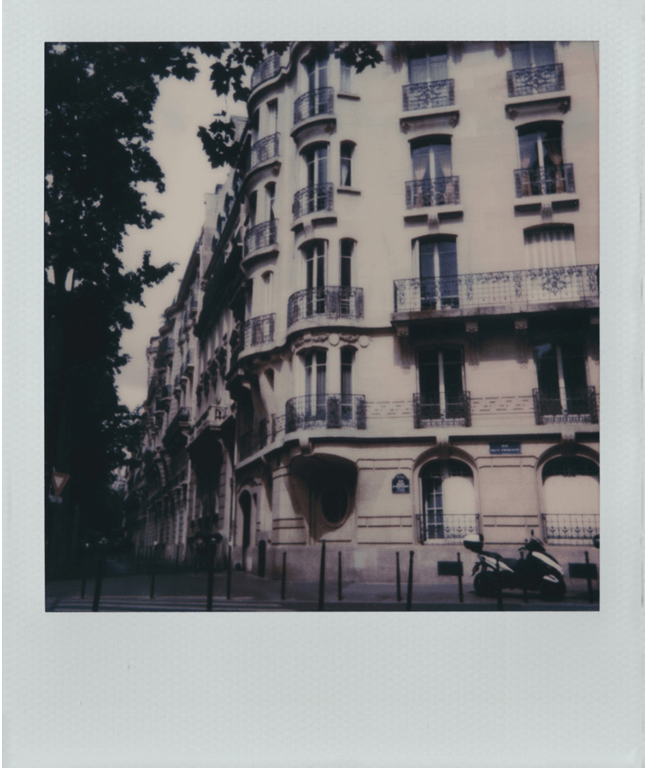
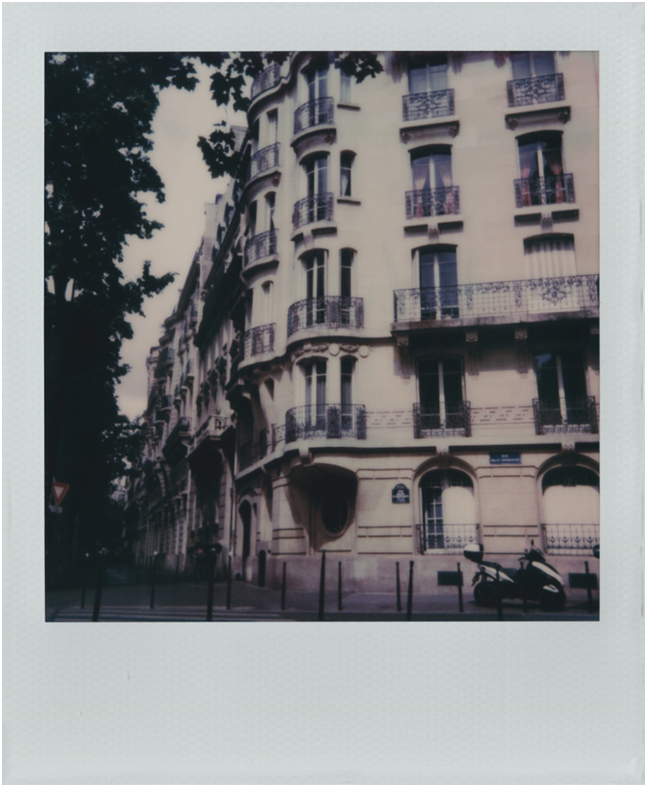
The flat was 84 Avenue Niel in the 17th arrondissment, a lavish building covered in unsual stone ornamentations, overlooking a wide avenue that is boarded by trees and severely uncomfortable benches. In a Deleuzian vision, life and death share a constant relationship, especially when seen from the perspective of a writer; a profession where a sense of the negation of death is strangely tangible. I wasn’t sure why I’d wanted to see Deleuze’s flat several years after my time by the window in Liverpool but I felt certain that it wasn’t out of a morbid boredom; more out of a desire to walk his ideas, to bring them out of the page and into the corporeal realm.
I wandered there on an uncomfortably hot day, losing my way as Montmartre turned first into Batignolles and then Ternes. The window was open on what I presumed to be the flat that was once his but there was little in the way to suggest that the place had been marked by a death. Every inch of any city is probably invisibly marked by death anyway, footsteps treading over little graves with every pace. And I was about to add my own little grave, one in memorial to that moment through a Polaroid.
Deleuze wrote of Francis Bacon’s paintings that ‘the active is that which descends, which drops. The active is the fall.’ Like Bacon’s descending oils, dripping in violence and desire down the canvas, this flight from the window and illness was not one of pessimism, but a last affirmative action; an escape from the limitations of the body, trapped in endless cycles of debilitating repetition and illness, seeking one final difference, one last Paris. The Polaroid rendered his street deathly, just as it had done my own face after I’d almost followed Deleuze out of the window.
…
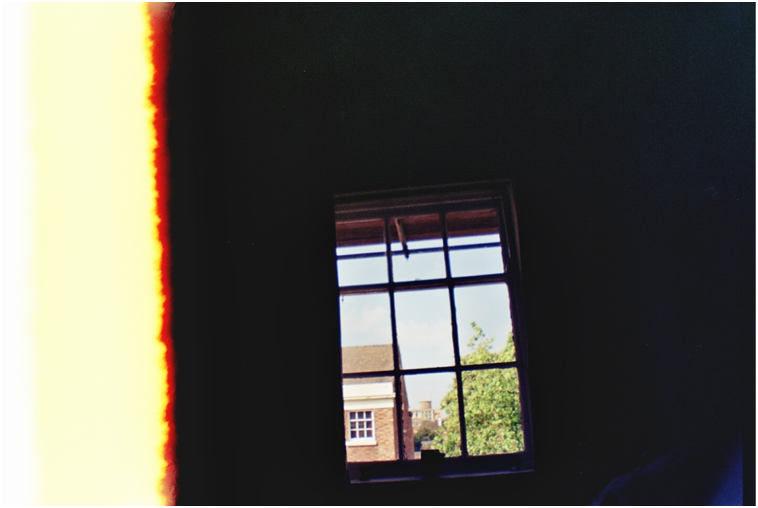
Before moving out of that flat in Liverpool, I decided to take another photo of the window. I’d since sold the Fuji Polaroid camera on eBay, fed up with its small format and haunted by the likelihood that the only really interesting photo I’d managed to take on it had been reflective of my own suicidal tendencies; hardly a ringing endorsement for any camera.
I was back to using my lomography box, much to the dismay of my sore thumbs which had assumed the torment of the camera’s sharp reel winder to be over. I can’t recall the exact day it was taken but the image, when finally returned from the developers, was interesting in a different way. It didn’t have the deathly qualities of the Polaroid, quite the opposite. The room was cast into shadow but the light from the window pierced the blackness. It was also the end of the reel so it burned at the edge as if set alight.
It didn’t possess the presence of the moment or any of that room’s previous atmospheres. It was simply a room, a window; nothing. Sometimes this is all people want from a photo, and rightly so. An impression of something once important, nothing more. It was missing the charge of the Polaroid and, in hindsight, I’m glad.
One thing is for certain, however: Polaroids and death live hand in hand.
 Celluloid Wicker Man
2 thoughts on “Presence, or Polaroid Ghosts (Part 13)”