

Around eight years ago, I made my first “fake trailer”. Partly in response to Ben Wheatley’s (and Amy Jump’s) adaptation of J.G. Ballard’s High-Rise, which I felt somewhat missed the mark, I edited together a “what if” trailer for the book if it had been adapted for BBC television in 1975. The responses to it, along with those to a follow up trailer (looking at whata 1970s adaptation of Derek Raymond’s Factory novels for London Weekend Television might have looked like), still bring me great pleasure; not least as the most regular response is a request to be linked to the fictional series.
Eight years later, and I have another fake trailer to share; a follow-up if you like to the previous Ballardian effort in the form of a period Thames Television adaptation to Crash. However, before writing about how this short little effort came about, a change in between the first of these and this one really struck home. While the techniques and research required to put these sort of things together has not changed (and remain as difficult and as tricksy as ever, requiring a hand in editing but also knowledge of older television that only really comes with endlessly watching it in bulk), the cultural landscape it is released into certainly has. I am, of course, referencing the vast changes in creation afforded by AI.

I am sure, if willing to spend money, someone savvy enough at the slavish instructioneering required for AI video production could have produced something vaguely like this. I have seen, for example, live-action feature film trailers for versions of older games such as Zelda, AI visuals to accompany the audio Doctor Who stories of Big Finish, and even a 1950s-style trailer for the Terminator films. But none of it really works for me, and there is a relatively simple reason as to why: it is a digital phenomena. It cannot get the imperfections of analogue quite right (at least not yet). The threat of AI is most felt in the digital world; those immersed in the consumption and creation of any sort of analogue culture (and I include some kinds writing in that as well, not the “very online novel”, for example) will see through such facsimiles a mile off. It has little currency beyond a more advanced search engine for research, and even then it is flawed. It lacks the imperfection that was supposedly wiped away when we idiotically allowed our creative industries to throw in the analogue towel and go down the cheaper route. Little did they know that they were likely sowing the seeds of their own rather bland demise.
Anyway, to the trailer in hand. Crash is really my favourite of Ballard’s novels. It is uncomfortable enough to put off the perpetually offended of modern readers (thank God), is immersed in the kind of grimy London that I culturally inhabit more generally, and is easily the strongest distillation of Ballard’s ideas. It is a novel of post-war tarmac and concrete, of sex and machines. Its influence is still reverberating.
It came as a surprise, then, to find that the spark that kick-started work on this trailer was watching the early 1970s series Man at the Top rather than something particularly transgressive. A television series based on the exploits of John Braine’s Joe Lampton (of Room at the Top fame), the quiet suburban sleaziness of the series already brought Ballard to mind. Then a pivotal moment in it was built around a fatal car crash and the kindling was lit.
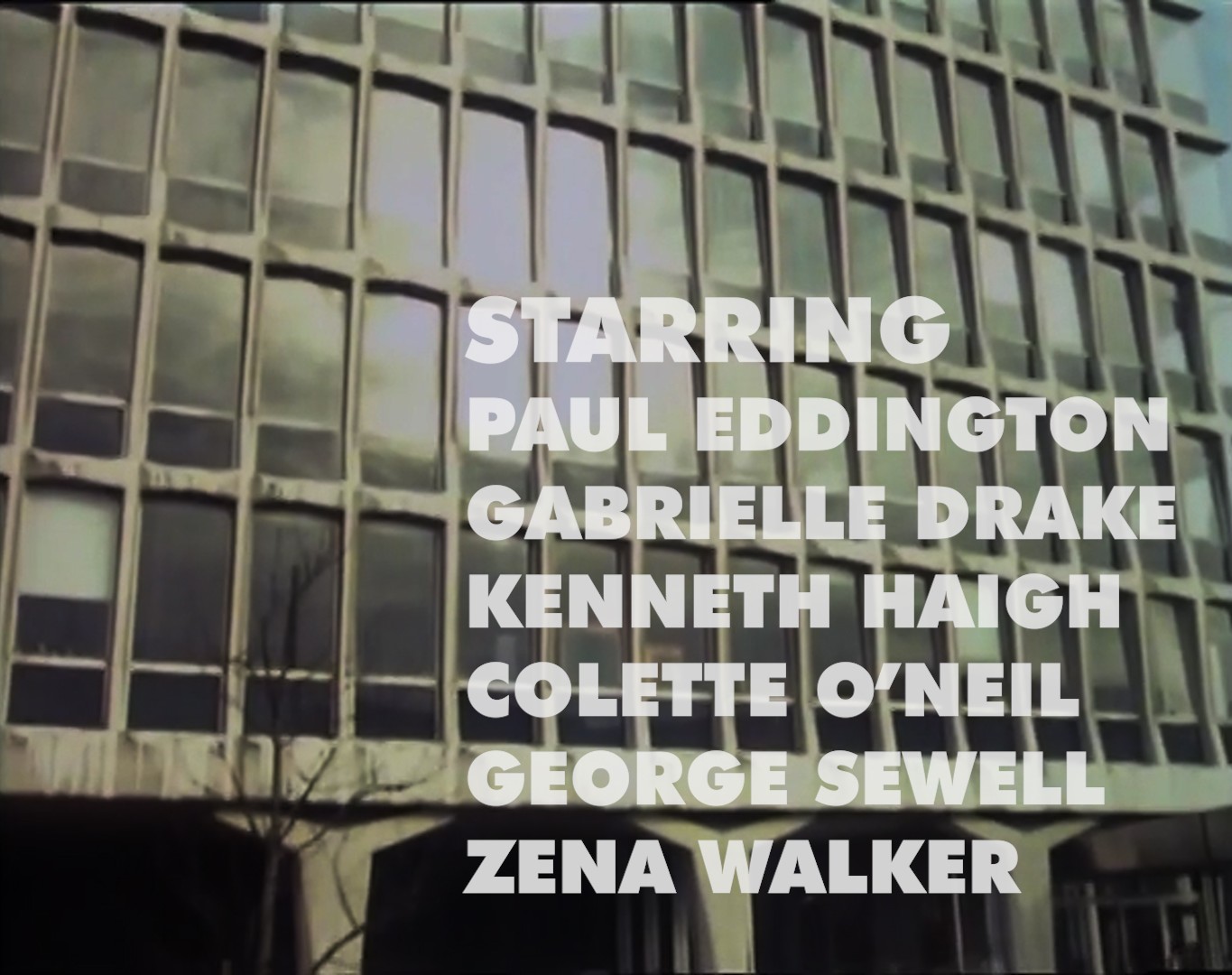
I cast Gabrielle Drake as the female lead, partly because she is in an episode of the series, and partly for her role in the astonishing BBC essay film version of Ballard’s ideas called “Crash!”. I have resisted trying to rip too much from this perfect short film as it would have been too easy; just a few shots of Drake and some 70s street furniture (as well as a cameo from Ballard himself). Elsewhere, I cast Paul Eddington as the male lead, meaning I could draw on footage of him in both Man at the Top and The Good Life. There was always something quietly Ballardian about Margo and Jerry.


It may seem odd to have chosen Crash to do this with. David Cronenberg famously adapted the novel in the 1990s and so two screen versions already exist technically. But Crash (1996) has always struck me as yet another miss in regards to adapting Ballard. The move to North America from Britain makes sense on paper (the land of highways and big cars etc.) but fails to capture the oily, pulsating pressure at the heart of the book: namely, the unleashed repression of London. Crash is a London novel. It is as tied to the topography of the city as Dublin is to Ulysses. Uncoupling them was a mistake, and I wish Cronenberg had discovered his later penchant for filming in London (in the likes of Spider and Eastern Promises) before adapting Crash.
Still, here is the trailer, made without AI. On the day I finished it, I was advertised an application for an AI girlfriend on Instagram, much to my partner’s bemusement. While I hope this trailer captures the spirit of Ballard, it is really not that important if it does: it is his future we are living in after all. His world is ultimately inescapable because it is ours.

 Celluloid Wicker Man
One thought on “Trailer – J.G. Ballard’s Crash (Thames Television 1974)”