
Remembering
Afterimage
‘At times,’ the Nobel Laureate and novelist Patrick Modiano writes, ‘it seems, our memories act much like Polaroids.’ This interesting thought comes from the semi-autobiographical perspective of a character in his novella Afterimage (1993). It is a narrative filled with strangeness, derived in part from the recollection of memories once forgotten; put to one side, left in the back of a drawer and hidden away due to shame and confusion.
Modiano is a writer preoccupied by time and memory so it is fair to give some credence to his statement. He details further why memory expresses itself in Polaroid form above all others. ‘The memory of him had remained dormant,’ the character suggests, ‘but now it had suddenly come flooding back this early spring of 1992.’ Very much like an MP3 file, Polaroids remain inactive until perceived. They are dormant, waiting patiently for exposure to our attention before releasing their information with an unusually fresh and unnervingly preserved essence. Modiano is unknowingly discussing the presence that Polaroids posses; the return of memories within us, time regained.
The question of time’s relationship to a Polaroid is a complex one. The reason behind this complexity is quite simple: photography as a form is already memory-ridden. If the point is that memories, personal or intuited, are retained through photographic processes, why focus on Polaroids specifically rather than photography as a whole?
Time has been associated with photography since it was first discussed seriously as an art, so it is natural to assume that a Polaroid would have some relationship with time. Susan Sontag, for example, labels photography as ‘a short cut’ due to its ability to turn ‘the past into a consumable object’. Photography does not memorialise our lives for Sontag but commodifies it, to the point where the action of casually taking photographs becomes a more dominant act than experiencing the very things we wish to remember.
Why did Modiano choose a Polaroid for his metaphor then, and even more unusually in a short story that follows the archiving of photographs in more typical forms? The fictional photographer of the novella is suggested to have worked with the American-Hungarian war photographer Robert Capa, and so, with memory being the key point of conjecture for the narrator, why use Polaroids as opposed to the 35mm at the heart of the narrative? What is it that Polaroids do differently that a writer like Modiano saw as a stronger metaphor for recollection?
The answer, which can be endlessly expanded, is explained by presence, and it opens up the unconscious potential we are all quietly aware of when we look at Polaroids. Memory is retained more precisely because it is twofold in Polaroids: the memory of taking the image and the memory of looking at it.
There is an unconscious idea which seems to underpin Modiano’s use of the Polaroid metaphor, one that finds some source in the French language. The French for memory is souvenir, and Modiano specialises in those souvenirs that have been hidden for a variety of reasons, usually through narratives concerning collaboration and resistance during the occupation of World War Two. Yet, when I write souvenir in English, the shared but slightly differing meaning of the word comes out.
When we use souvenir in English, it is to describe an object explicitly linked to where it was bought. This process is deliberate rather than accidental and generally brings to mind the twee rubbish found in the self-proclaimed souvenir shops of tourist destinations. To my mind, it conjures a very particular image, one of a “pet rock” bought in Cornwall on a holiday many years ago; a large pebble that had googly eyes attached and housed in a wooden cage. Souvenir is a word that forever reminds of the cliffs around the Cornish coast from where it was bought, even if totally absurd as an object. This is how a souvenir, no matter how silly, is meant to work.
The point of a souvenir in English is that the memory can be rekindled when reunited with the object. We buy souvenirs to ward off forgetfulness of happy times, natural or forced. The object is a trigger, one that can take you back to the place where, if all was well and the rain held off, happy memories were gathered in abundance.
The implication is that objects have a stronger potential to retain memories than if they were left to incorporeally float of their own accord in our murky and slowly disintegrating consciousness. The ghostly absence of physical qualities in digital photos is why they seem less potent as souvenirs to me.
The photograph in general has been, historically since its ease in accessibility, the souvenir of choice. Holidays are reduced almost uniquely to an array of photographic opportunities in the endeavour of remembering those moments, even though such moments will be marked mostly by the act of taking a photograph rather than anything else. Holidays are photographic quests for future souvenirs, something which makes genuine holiday Polaroids from strangers and older eras incredibly interesting.
A Polaroid has obvious and overt differences to general photographic souvenirs because of its presence. With a Polaroid, we are taken back to the instant, not just of its capture but of its witnessing; drawn back to the instant of observing the recreation of a reality that we were pleasantly living through.
If I think back to the small Polaroids from the myriad nights out on a friend’s student flat wall again, the time of those nights seemed so contained because the object activated other senses such as touch (if brave enough) and smell; the stains of a good night out, shoe prints trodden from a messy club floor, the colourful, sticky drops of cheap alcopop. Such casual photos reveal a wealth of lived experience. It is not simply archiving or documentation but the real essence of a messy night out in Liverpool. If photography does turn lived experience into a souvenir, then the Polaroid takes this a step further because it lives with us and gathers other things on the way just like we do.
The Polaroid has become shorthand for memory, as has its palette and aesthetic. Those hazy colours, faded yet vivid simultaneously, have become so synonymous with personal memories that it is unsurprising to find today’s casual photographers spending just as much time adding filters and colour curves to their digital photos to recreate the same Polaroid palette, almost as an attempt to give analogue legitimacy to their digital memories. They live in an age of colder instant photography, where the imperfections of the analogue have become symbolic of cherished moments.
When reading Modiano’s books for the first time, another writer came to mind. Marcel Proust had an unusual fascination with photography for similar reasons to Modiano, and was also known for his own examination of memory. I often find myself thinking of Proust’s title for his epic and expansive work In Search of Lost Time when thinking about photography in general, chiefly because it summarises photography’s raison d’être. What are photographers really in search of if not lost time?
More specifically, photography is in search of that which is constantly being lost through the ongoing instant of existence. Proust was astute in understanding the process that photographs went through after their initial creation, something often unconsciously acknowledged rather than celebrated, but also explaining why many of photography’s most famous analysts often look to him for ways of understanding the art.
It is a fitting technology to discuss in his work as its melancholy, caused by inevitable change and loss, resembles Proust himself. He outlived all that he held dear. Photographs of most kinds will do the same. We all become photographic echoes eventually.
Proust wrote that a photograph ‘acquires something of the dignity which it ordinarily lacks when it ceases to be a reproduction of reality and shows us things that no longer exist.’ In other words, a photograph gains something over time because it outlasts what is photographed, especially in regards to people.
Photography is a memorial art.
In Proust’s case, this is poignant for two reasons. The first is that his whole project of In Search of Lost Time was instigated by recognising that memory and time were contained in objects. In his case it was the Madeleine cake, its taste combined with a certain type of tea famously transporting him back into his childhood with such alarming depth that it resembled Alice wandering through the looking glass. The second is that Proust’s subject was humanity. Therefore, photography is a medium doused in loss because it outlasts the human subjects within it. He witnessed this disappearance and it became a depressing realisation that hung over him as he sat in bed trying to conjure as much detail as possible through a writerly séance.
In today’s accelerated climate, my own Polaroids attain the same melancholy but for different reasons. Whereas Proust saw photography as gaining qualities in memorialising those he had lost, my own Polaroids memorialise the passing of time. Simply because of my chosen subjects – the houses and graves of writers, locations used in films – my own Polaroids are beyond what is lost because of the era I am living in. Things are already lost in my own Polaroids: time moved on before I was even born.
If Proust could not use a Polaroid for his own epoch, then I could at least use it to explore his haunts. Photographing such things is a pleasing connection even if they fail to fully acquire the dignity he finds in photography once their subjects have vanished beyond the pale. It is more of a cultural archaeology than reproduction or archiving. Or perhaps it is just a sad hobby that requires little intellectual justification except that of someone who chooses to spend more time with their memories than people, just as Proust did.
Proust’s famous bedroom where he wrote much of his most celebrated work must have been dark with recollection. It is impossible to read the thousands of pages of his words without seeing them come into being in his barely lit Parisian chamber. It was his darkroom of sorts, slowly developing what had once been into images and stories. Cocooned within his cork-lined literary nest, spreading memories like thin strands of cobweb, Proust needed his room to act as a blank canvas upon which his past played out.
There have been many depictions of Proust’s bedrooms, often amalgamating different houses in Paris where he lived. The result is often a Proustian jumble sale but pleasing all the same. The writer lived in Paris since childhood, firstly with his parents at 96 rue Fontaine in the 16th arrondissement where he was born. Proust’s family had moved there after their first house had been disturbed by the rumblings of the Paris Commune. Though the writer lived in several other properties with his parents, alongside their famous trips away to various hotels and houses on the Normandy coast, he first lived alone in his mid-thirties after his parents had finally died. Moving to 102 boulevard Haussmann in 1906, the writer soon took to his bed, a penchant for early nights being an admission that opens his novel. ‘For a long time,’ he writes, ‘I went to bed early.’ He soon started work on the book which was to occupy the remainder of his time.
The process of writing becomes something that is isolating, another illness to add to Proust’s growing collection. It takes possession of his life as more and more reams of paper litter the bedside. His body fails to last the stretch needed to see the whole endeavour published. He is engulfed by the momentum of his own memories as time slips away. How much easier his work would have been if he had been a photographer.
Recreations of this scene for drawings of the writer will undoubtedly be taken from images of his last place of residence, 44 rue Hamlin and the bedroom which is famously recreated in the Musée Carnavalet as a rather corny exhibit, the Proustian equivalent of a Downton Abbey-like nostalgia. Rather than a desk, however, Proust is always tied to his bed. Recollection is best considered when comfortable.
It was Christmas Eve when I decided to go in search of 102 boulevard Haussmann. There was an element of deliberate isolation in my wander; that after months of work, no energy was left for the sort of forced social niceties demanded by Christmas. I was not sure what I thought a Polaroid of the building would capture but I knew the visit would at least raise some questions regarding time, even if those questions were more about personal responsibility regarding seeing loved ones over the festive season.
Closing in on the 8th arrondissement, the results of the recent uprising of Gilets Jaunes were readily apparent. The area felt unusual, volatile even, as windows were barricaded, their insides darkened in conspiracy and worry over what was to come. It only became clear from walking further that every building attacked was a bank; windows smashed, revolutionary graffiti sprayed upon stone walls and cheap wooden ply board acting as make-shift barriers against the cold. Would a Polaroid of this bruised and battered Paris really touch upon Proust’s delicate realm?
Finally on boulevard Haussmann, suspiciously empty and pavements blocked by building work, I began to look out for building numbers. I almost walked past the house in question as 102 boulevard Haussmann is now also a bank. Its windows were boarded up like a squatters’ paradise. Even its main door was closed, an occasional customer confused as to how to get in before noticing a tiny side entrance that had been opened in its place.
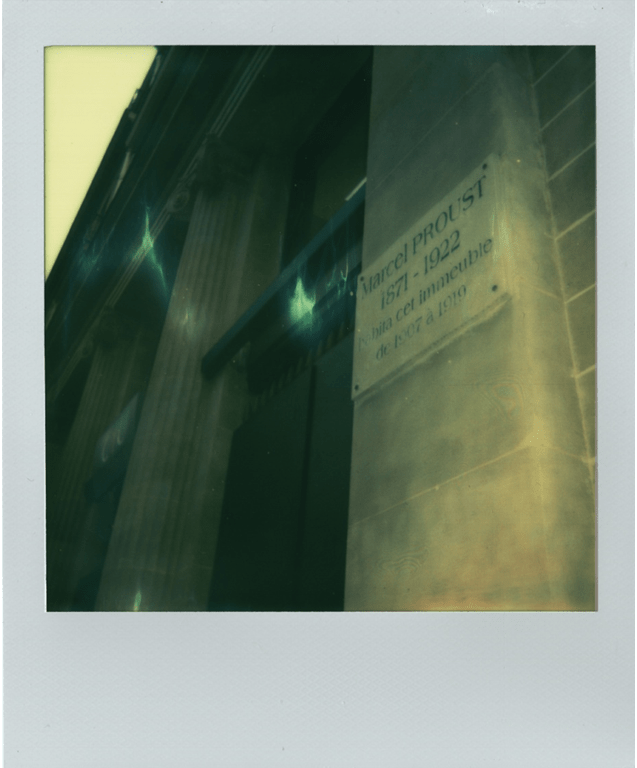
A large plaque on the wall celebrating Proust’s time there had thankfully been left alone, the ire of the protestors aimed solely at what occupied the building rather than the building itself. I snapped the Polaroid and sat on a stiff, frozen bench opposite, trying to imagine Proust’s room now. But I could not. It was still darkened, yes, but by boards covering broken glass.
I can still see him, writing away as the world turned; barely looking up to see the turmoil away from the page. But it is not there in the Polaroid. The present was simply too charged. Only my time from my visit appears to my eyes today. Proust himself was just an echo now, my wander after him conducted far too late.
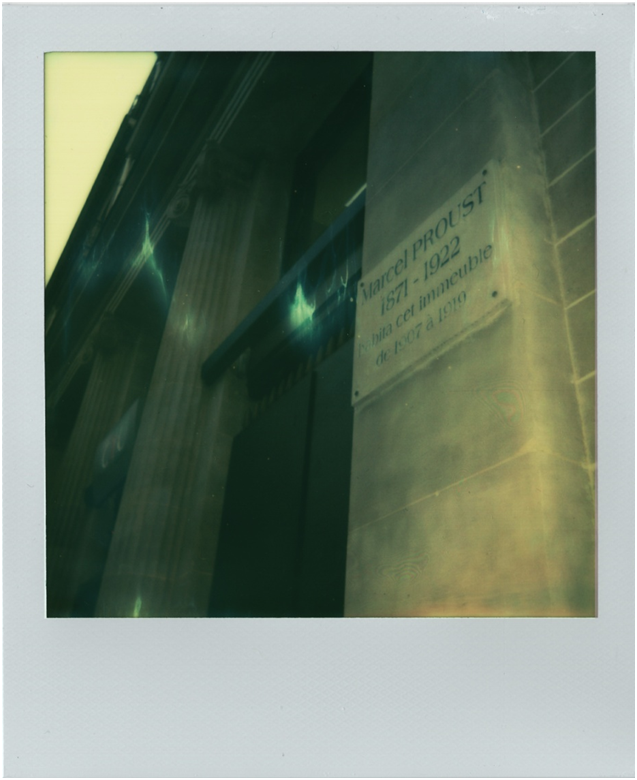
Proust’s Polaroid, however, did become a souvenir. It denoted the reality it was taken in more than the world inhabited by the author that inspired it, but perhaps other epochs would be perceivable to viewers other than mine. My perception is only one of billions.
Time is contained within this Polaroid, my own time on that lonely winter’s day, but also that of the subject. In many ways, the combination of the photograph’s subject and the ambiguity held within a Polaroid creates something unusual, a sort of timelessness that insinuates that the photograph is some way into the past. Because it is already old, it does not age in the same way as other photographs. The smashed windows could be from several decades ago. Anachronisms become rife within the grain.
It is a sort of banal time travel.
…
I often give Polaroids as gifts or souvenirs to others, though the act is a strange one. Sometimes I think that these Polaroids are playful in their ambiguity. Are they really taken by me or did I just find them? Their age suggests the possibility of trickery, especially when the subject is unquestionably of our era. John Berger explored this question most intensly. ‘If we are looking at an image from the past and we want to relate it to ourselves,’ he writes, ‘we need to know something of the history of the past.’ But what if the way a photograph looks is already in communion with the past, one we do not know much about?
I hope that these are the questions that come to mind for those gifted with occasional Polaroids of mine. It is a gift of a moment, no matter what the subject may speak of. I have gift-wrapped an inconsequential fragment of my experience. It was also only lately that I realised, however, all but one of my gifted Polaroids were of graves.
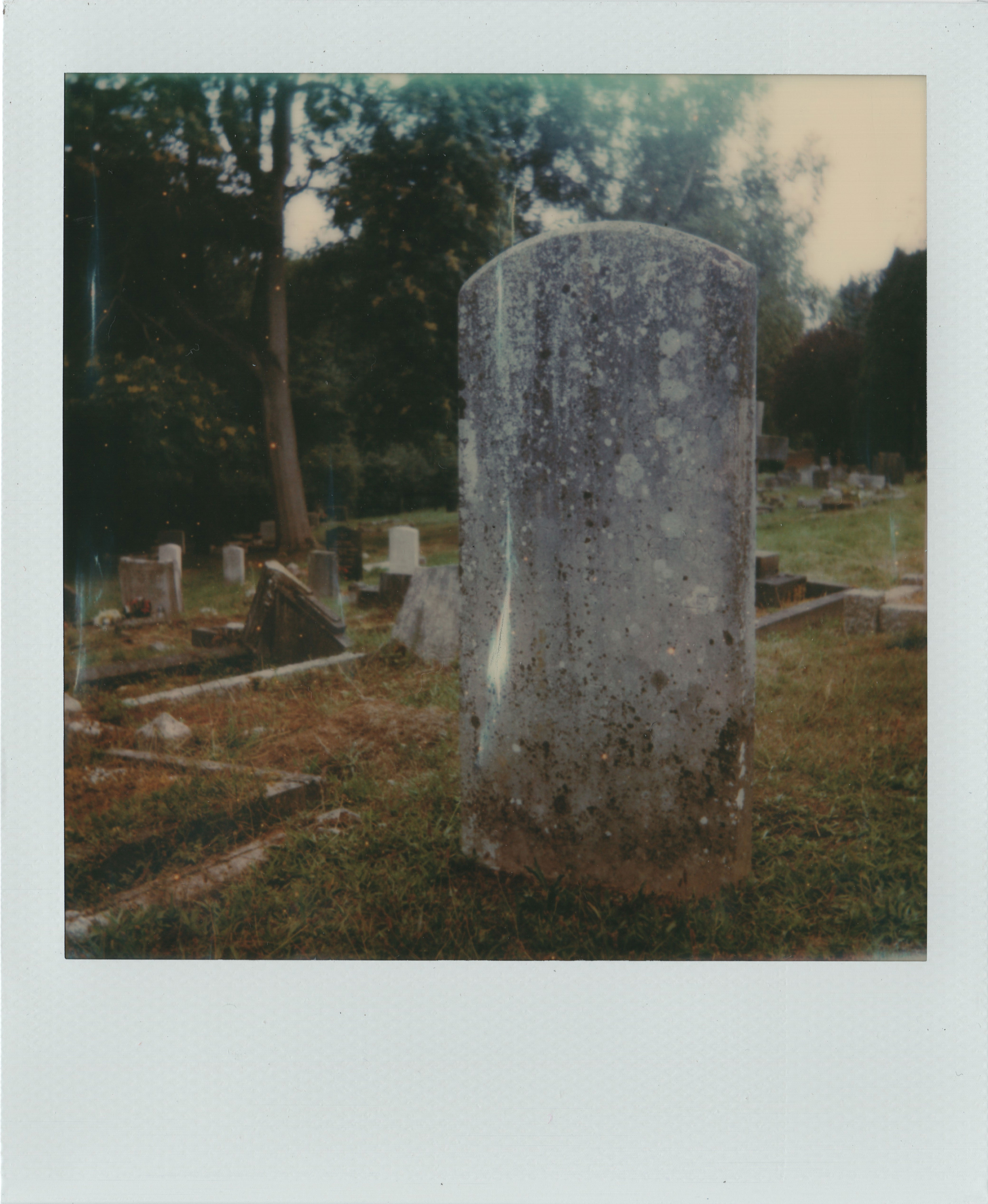
To my publisher, I gave a framed Polaroid of the grave of the weird fiction writer Arthur Machen whose green shades suggested the very air of that day to be hazy with moss.
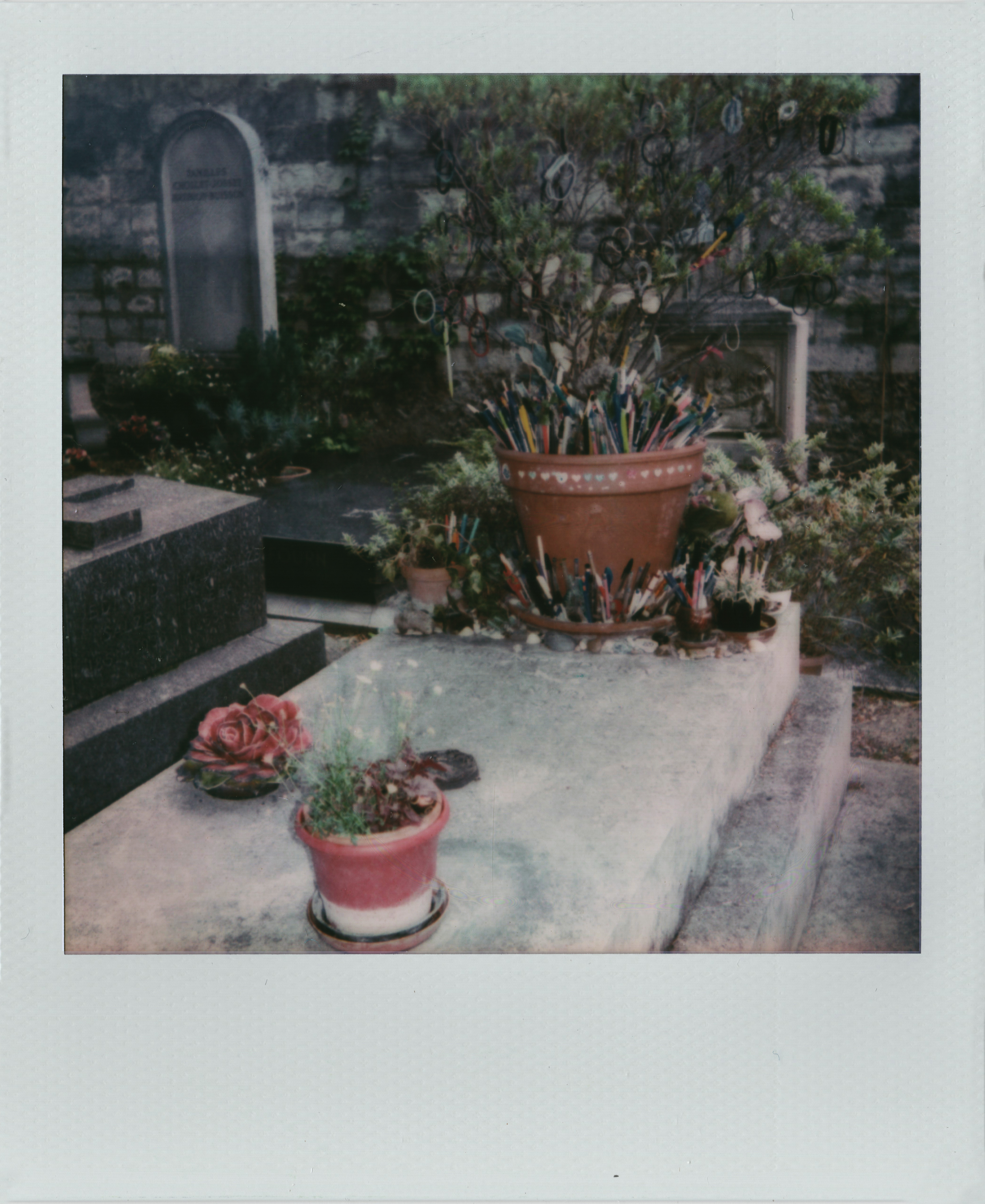
To the writer Deborah Levy, as a gift to say thank you for attending the launch of my second novel, I gave her a photo of the grave of Marguerite Duras in Montparnasse Cemetery after we had shared a discussion relating our affection for the West Bank and our questioning of the hipsterish glaze currently coated over Belleville on the other side of the river. I did not tell her of the man crying next to the grave as I took it.
And to my friend Ellen, the photographer who gave me my first proper Polaroid camera, I gifted a Polaroid of the grave of M.R. James in Eton, a writer who we both love; an eerie photo in solitude but one that ultimately brings to my mind the surreal sight of young Etonians whose IPads clashed with their top and tails.
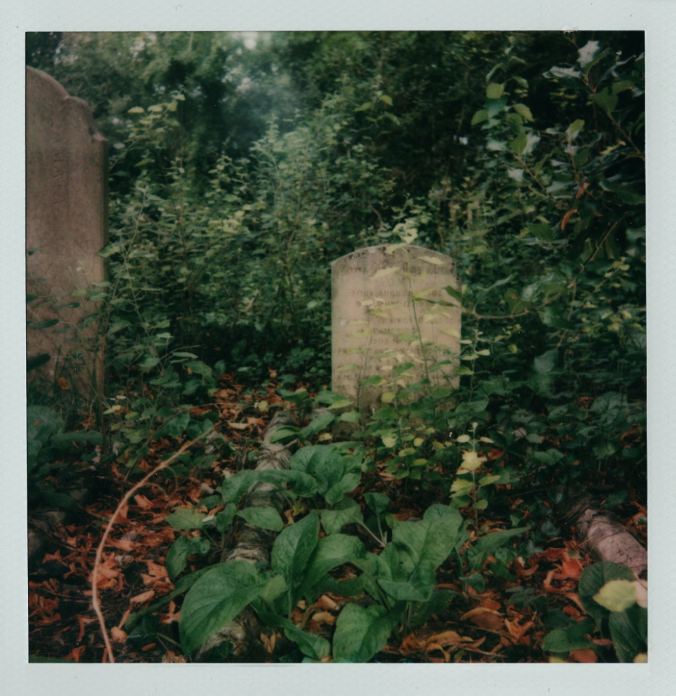
When gifting these Polaroids, I hope that the result is not morbid but one of gifted time: I gave my time to these journeys and these were the companions I brought back on my return.
Time works in a multitude of ways on these images. My publisher, for example, was there in witness to the Polaroid of Arthur Machen’s grave, took during a walk to visit the house of the writer John Milton in Amersham. I imagine the Polaroid brings back memories of the time of our walk with its gentle rain and endlessly joyous shards in the sky created by the increasingly common Red Kite population. That Polaroid will play on his memories as well as mine.
Time is given in these Polaroids. As Chateaubriand once remarked ‘It is not man who stops time, but time that stops man.’ In a normal photograph, if such a thing exists, this would likely be the predominant impression; that these are melancholy images because they show the absence of great people. How can an image of a grave be anything but one that speaks of loss? But a gift of a Polaroid is a gift of the photographer’s lived time and their witness to those moments, even if the recipients were not there and the subjects were decidedly dead.
There are two distinct layers of time in Polaroid photography because of this: the hindsight and time that has passed since it was taken, and the more abstract time that the form implies through the associations with its style.
There is a reason why postcards in the format of Polaroids can be purchased today from most gift shops. Like a postcard, a Polaroid is a gift of memory and time, only more charged as the person gifting it made the thing. For those who do not have a camera, a postcard with a fake frame and formatting of a clichéd Polaroid image is the next best thing. ‘Here’s something to remember,’ such a postcard suggests, while ironically relating nothing of the kind in its design in personal terms.
Susan Sontag would have hated this idea, though she was perhaps more in-step with the real world than I am. She believed that photography ‘was not meant to lead us back to an original experience.’ In fact, she described such a desire as rueful because ‘the old world cannot be renewed’. I wonder whether her opinions would have changed as photography morphed in the digital age, and whether such criticisms are marked by the fact that her time of writing was when Polaroids seemed to be little more than casual snaps of a dying format.
Teju Cole suggests that photography provides us with the ‘memory of something we have never seen.’ This is especially true of photographs that were actually there. Time is engrained within them, fading their colours, committing that increasingly criminal act of ageing. Even when they are new, Polaroids seem old. They are from an age where tangibility and imperfection was inescapable.
The Polaroid ultimately raises a quintessential question in regards to photography. What are the aims of capturing something indefinitely? Looking at Polaroids through their relationship to time somewhat answers this question, but for me it will be a mere elongation of ideas explored more succinctly in a little known French film by Claude Miller called Random Killing (1983) or Mortelle randonnée.
In the film we follow a detective played by Michel Serrault. He is charged with following and investigating a young woman played by Isabelle Adjani who is actually a serial killer. She makes her way around Europe, seducing and murdering a number of rich men in what seems to be the typical manner of a stylish 1980s thriller. But stranger things are implied from the beginning and what unfolds becomes an exercise in memory; one which concludes with the detective and his Polaroid camera.
Before the detective (or the viewer) has seen his subject of investigation, he is walking with his Polaroid camera through a park towards a fairground. He gives the camera to a young boy so he can take a picture. Clearly the machine has a magical quality in the eyes of a child. The boy takes a photo and after a while the detective looks at it. As it develops he sees the woman he is following appear in the photo and, moments later, a cut subtly implies that she runs out of the photograph into reality; out of the frozen moment into the slipstream of the now.
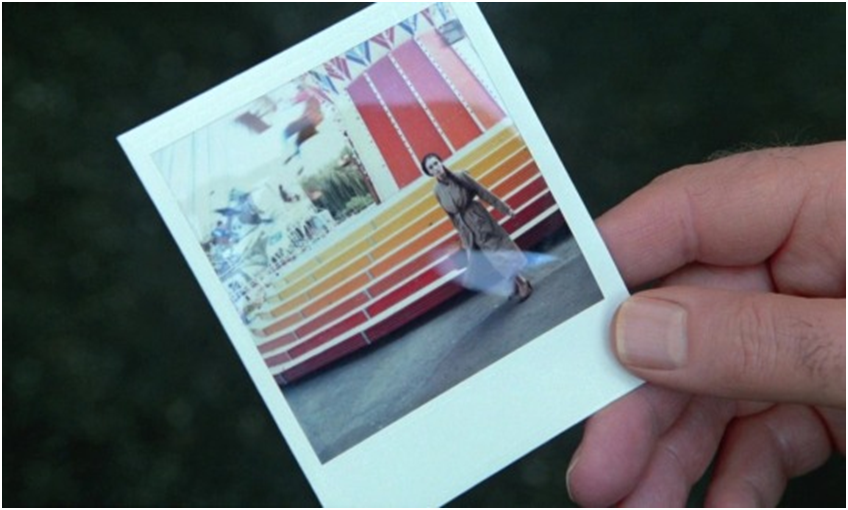
The film is ambiguous about the relationship between these two unlikely characters. The narrative reveals that the detective is haunted by the loss of his own young daughter. He carries a photo around from when she was at school but heartbreakingly cannot identify which of the girls in the photo is actually the daughter. His life has been spent trying to figure out which girl was her.
Was he already estranged from her? Has his potential grief from losing her disrupted his memory to such a degree that even the possibility of seeing her in a photograph fails to rekindle recognition of who she is? He takes on the case as part of his wider search for his daughter either way, suspecting that the woman may be his lost offspring. The film turns surreal as the woman’s crimes (and the detective’s increasing complicity in them) become more extreme and bizarre.
Eventually, the delusion is stretched to breaking point. The detective becomes aware of his loss, unable to fully let go of the fictional world in which his daughter was briefly returned and vibrantly alive. It is a remarkably strange film but its final, beautiful moment for me realises perfectly that same relationship I feel when looking at Polaroid photographs.
In those last few moments, the detective is stood in a graveyard where the reality he was hiding from is unavoidably housed. His daughter is dead and the film has been one headlong dive into a fantasy away from his consuming grief, imagining a future in which she grew up. The detective then has a decision to make.
He looks at the photograph and his choice of pathways becomes apparent. He could accept the death, grieve and continue living. Or he could dive back into the fantasy and disappear from the real world completely. ‘He opened the door,’ the narrator of the film concludes, ‘and went into the photo.’ The Polaroid here is not merely a metaphor for memory as in Modiano’s story but a realm of its own.
I not only feel this same allure in my own desire to take Polaroid photos but also in looking at those of others. In seconds, I can escape from troubles, thoughts and fears, back into different times and the memories of strangers.
When we look at Polaroids, we too travel back in time. Like the detective, we open the door and venture into the photo.
Whether we ever return from their grain, however, is another question.
 Celluloid Wicker Man
2 thoughts on “Presence, or Polaroid Ghosts (Part 8)”