
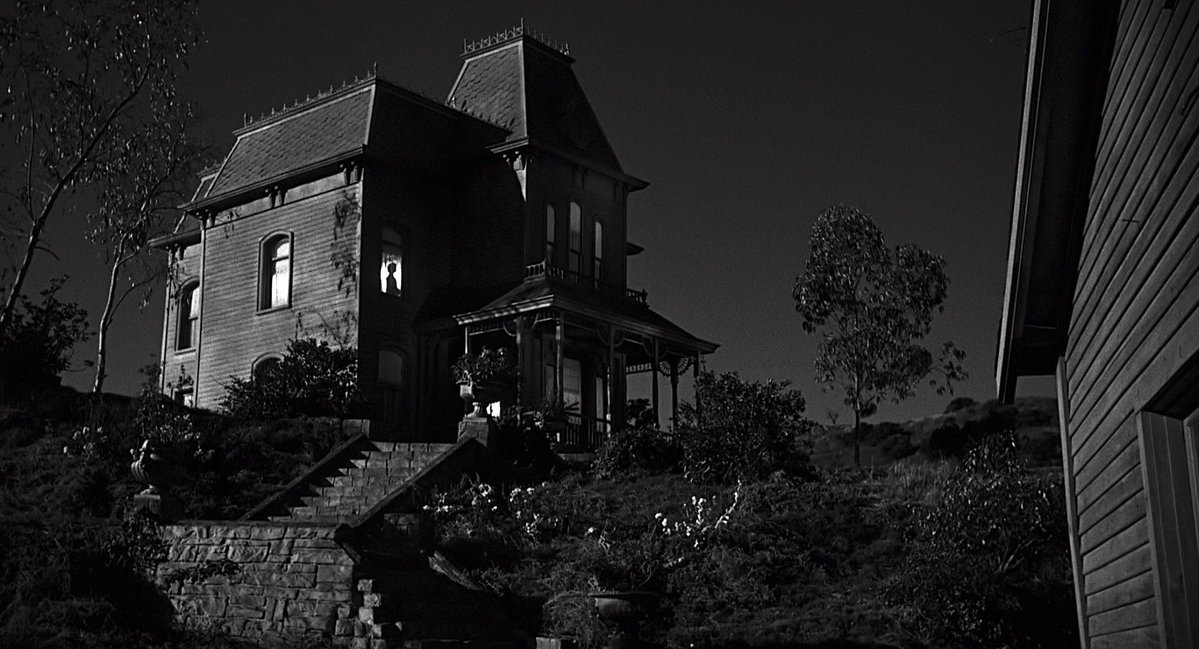
One of my favourite moments from Alfred Hitchcock’s Psycho (1960) is not a typical choice considering the film’s many infamous scenes. Rather than showers, murders and other more memorable images, I particularly love a relatively bland scene later on in the film. It has narrative development in its eerie punch line but has little else on screen in terms of Hitchcock more generally: it is utterly perfunctory in comparison to most other things in the film.
The scene captures something I have found in a range of horror that is difficult to describe; a pleasurable sense of distance from a place of horror already mentioned. Whether this is distance in terms of the characters and the space they inhabit at that moment, or in the viewer’s sharing in that warmth away from a place where horror is seeping out into everyday life, this distance is something I cherish when I come across it.
The scene in Psycho is late into the story when the narrative is following Lila Crane (Vera Miles) and Sam Loomis (John Gavin) as they search for the missing Marion (Janet Leigh). Marion was on the run after stealing money but made the unwise move of spending a night in the Bates Motel where she is murdered by Norman Bates (Anthony Perkins).
In the scene, Lila and Sam are in the house of the local Sheriff Chambers (John McIntire) after paying an unsuccessful visit to the Bates Motel where Norman was suspiciously unhelpful. The punch line is that, having seen a figure of Norman’s mother in the window of the house overlooking the hotel (and Norman having spoken as if his mother was alive), the Sheriff drops the scare that Norman’s mother, someone we have heard speaking throughout the film, has in fact been dead for some time. ‘Well, if the woman up there is Mrs. Bates… who’s that woman buried out in Greenlawn Cemetery?’ he asks.
At that moment, I am glad to be in the Sheriff’s house, more than glad in fact. It is a kind of morbid cosiness. The viewer has some pathos as to what is going on though not the full picture of Norman’s illness just yet. Either way, there is a distance, thematic and aesthetic, between the two spaces.
The Gothic horror inhabiting the motel and mansion is very deliberately mentioned while in this small-town, homely living room with a figure of authority there with as well. The moment is eerie but it is a pleasurable distance, a sense of far-away malevolence. It heightens the feeling of leaving such safety and comfort once more in turn heightening the tension of returning back to face the gruesome reality of the Bates Motel and its macabre history.
I often think of the ghost stories of M.R. James working in a similar though not quite in the exact manner. While talking on a podcast a few years back, one of the points I raised in regards to why James’ readings of his ghost stories at Christmas worked so well was because of this similar contrast.
This contrast, in his strongest stories to me, often involved a wintery, desolate landscape in which spectres and unnameable revenants were approaching, seeking violent retribution upon the curious. From a warm, Cambridge fireside to an empty Norfolk beach in winter, the sense of distance is the same.
I am grateful to the various tellers of James’ stories, always really James as a singular voice to my eyes and ear when reading, that he conjures these images when we are at a pleasing enough distance to enjoy them. They are gifted a quality that implies the reader is some way away from where such horrors occurred or, worse, are occurring in that very moment. A Warning to the Curious does this especially well though, equally, I imagine the feeling being similar when watching any number of BBC adaptations of his work.
I think, too, of the moment in Jonathan Miller’s Whistle and I’ll Come to You (1968) where the image of the protagonist, Parkins (Michael Hordern), lying in bed is over-layered with images of the beach where he found the whistle. It is not a pleasant realisation for the character as the landscape and its menaces are returning slowly indoors to his hotel room. For the viewer, we are given a brief moment of distance and feel the cosiness of that creaking hotel; glad to not be out there in the cold, Norfolk night.
Perhaps the most alarming and effective example I have encountered of this feeling is in H.P. Lovecraft, and, even more specifically, in the story The Case of Charles Dexter Ward. In Lovecraft’s stories, this distance is part of the general mechanism for his menaces as the creatures at the centre of his stories are often beyond full description and comprehension, if the viewer is to remain sane that is.
In his case, Lovecraft relies on testimony from characters within his stories as to the horrors going on elsewhere rather than dramatic renditions of them. There are often cries in the distance. In The Case of Charles Dexter Ward, I have never felt such an acute sense of pleasurable distance, though it was, on first reading, unnerving enough to almost slide from pleasure into genuine anxiety.
In one segment, characters in a cottage recount what is unfolding on a coastline near the farm where the intrigue of the story swirls like sulphur vapours. Some sailors and military are sent to investigate (and end up fending off) something. The reader is never taken along with the sailors on their errand and is not witness to what happens to them.
Instead Lovecraft gives us evidence of people either returned from whatever it was that happened or people in a nearby cottage who heard and glimpsed fragments of what was going on. There are several different distances are here.
Lovecraft writes that ‘It was just before dawn that a single, haggard messenger carried a conviction which his mere words could never have conveyed: for though he was a seaman well known to many of them, there was something obscurely lost or gained in his soul, which set him for evermore apart.’ He then describes the scenario that left him this way through ‘muffled’ sounds before screams from the actual farm itself are heard and followed swiftly by silence.
All of this is told second-hand, implied, judged or related. It is never in the moment, just as when insinuations about Norman Bates’ mother gain a greater effect when placed away from the murky horror quickly becoming apparent at the Bates Motel, or in how much more pleasing it is to learn of cursed Saxon crowns when sat by a Cambridge fireside.
‘A wailing distinctly different from the scream now burst out…’ wrote Lovecraft in his unnerving short story. My first, and still consistent, reaction to this is simple: what a pleasure it is that such an affair is related from afar.
 Celluloid Wicker Man
I love this post. Totally makes me want to think about whether this was used (and how effectively) in some fave stories.