
In 1946, Jorge Luis Borges published the story, On Exactitude in Science. The piece is a fragment of a 1658 fictional volume written by the equally fictitious Suárez Miranda. Its story addresses the role of cartography, relying upon the ironic endeavour of a group of cartographers attempting to make a 1:1 scale map; the map referring back to the original with such precision that it sits like a second skin over the very place it was designed to map.
It is a typically Borgesian impossibility. Yet it was when reading this short that I started to think about cinematic mapping, about the time-image and cinema as a temporal medium as a whole. In other words, how certain possibilities deemed impossible in the plastic art of mapmaking found some familiar guise in the cinema. With this, the first film that instantly sprung to mind was Jacques Rivette’s strange but hypnotic film Le Pont du Nord (1981).
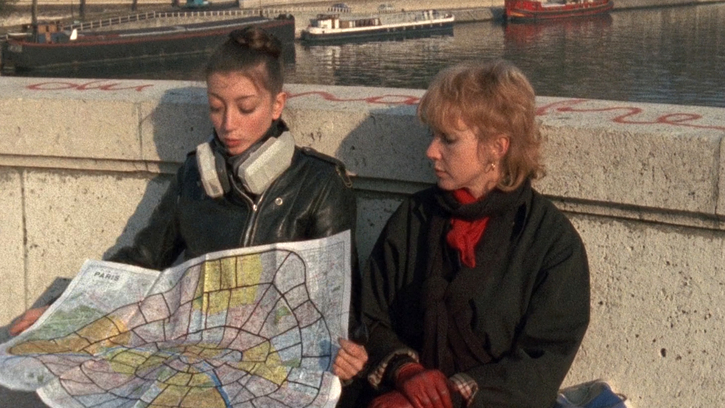
Rivette’s film follows two women (played by mother/daughter pair Bulle and Pascale Ogier) as they attempt to solve a mystery that takes them all over Paris. The city is in flux; being gradually redeveloped with buildings crumbling, land left to grow over and with even central Paris feeling unstable. The city becomes a game, quite literally, with the film’s narrative structured around the Game of the Goose.
A map of the city appears throughout, modified to account for this game’s restrictions, further enhanced by mysterious packages sent by Max (Jean-François Stévenin). Tying the film into Borges is a relatively reasonable proposition considering that the pathways all leading to some centre resembles a labyrinth.
The film takes on more of Borges’ ideas from On Exactitude in that the mapping of the city, 1:1, feels tangibly possible in the film; the process of filming measuring the city through time rather than physical space.
Rivette is one of the directors who embodies best Gilles Deleuze’s concept of the time-image and its basis in cinema. Time is no longer subordinate to movement in the images that are captured, according to Deleuze, and becomes directly present rather than merely represented. No cuts will ease its passing.
When Rivette films Pascale Ogier riding her moped repeatedly around a roundabout adorned with lions (Le Triomphe de la République in particular) the space is mapped by the literal time it takes for her to explore it. It is not the entirety of Paris but it is certainly a temporal cousin to Borges’ ambitious mapmakers; if the unnamed cartographers were filmmakers instead, they would likely resemble Jacques Rivette.
Rivette maps streets in real-time, or as close to real-time as is possible before cutting between segments. It is not an exact fit (he still cuts even within segments), but the drive is there, as is the potential to extend it. We forget sometimes when looking at maps that they are a measure of time as much as they are of space, even if not an accurate measure but instead an insinuation. This is a palpable element in Rivette’s film.
When the characters examine their maps, especially when comparing a variety of maps that they have come across – using one to decode the meaning of the other – I thought of what Borges said in his short story. ‘In time,’ he wrote, ‘those Unconscionable Maps no longer satisfied, and the Cartographers Guilds struck a Map of the Empire whose size was that of the Empire, and which coincided point for point with it.’
I cannot quite make the link to what this says about Rivette’s film, when really the maps and their meaning are deliberately unfathomable. But I feel for sure that the link is there. The best way to describe it is that these smaller maps heighten the sense of place in the film, that Paris was tangibly constructed through celluloid. In other words, the two characters were themselves in a map of sorts created by their own movements; where certain roads and places were mapped in the scale of 1:1, drawn with the cartographic randomness that can only be achieved via physically drifting through streets and through time.
Or it could simply be a meaningless game. Life, like cinema, can be like that.

 Celluloid Wicker Man