

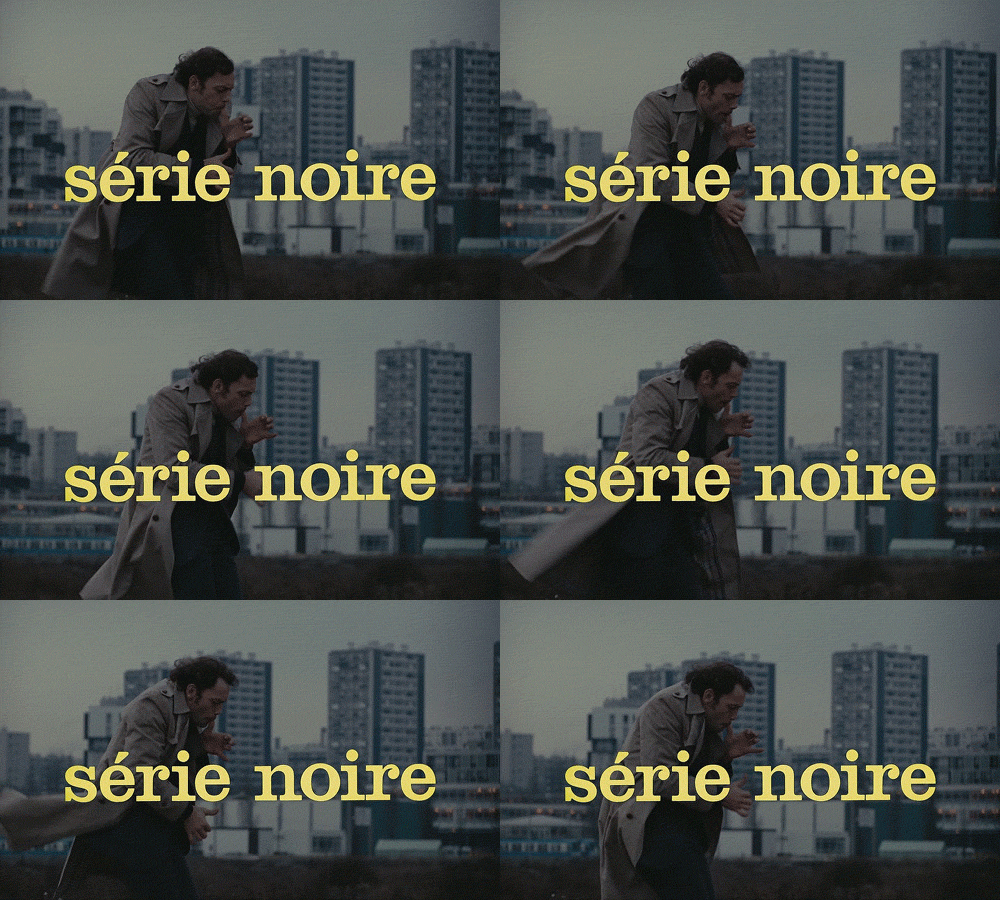
A man dances in a wasteland. It is a damp, empty landscape of grey, sticky mud. A burst tire lies next to a large pool of water where the man has parked his cheap car. Paris tower blocks rise depressingly in the distance; this is the very edge of the city, forgotten vistas where no one bothers to visit.
And yet the man dances. At first he seems nervous, looking around with the wide eyes of an animal expecting to be attacked. He runs back to his car as if diving for cover, slowly stepping back out into the sticky mud, about to reach for something; a gun of his own? He pulls out a personal transistor from his tattered Burberry mackintosh and hits the play button. He begins to bop to the rhythm of the music that crackles out, putting it on the car bonnet as he begins an invisible waltz through the rubbish with a woman who isn’t there.
This is the opening of Alain Corneau’s Série Noire (1979), an adaptation of Jim Thompson’s A Hell of a Woman (1954). Unlike Thompson’s novel, the film opens with a sequence that suggests nothing but the sadness and desperation of the lead character, and with what feels a deeply Gallic irony. Corneau had help in the adaptation from acclaimed experimental author Georges Perec, and I believe this to be one of the reasons for this opening; where the linking of the wasteland marks the loneliness and attitude of the main character, soon be shown as unstable, violent and hopeless.
The film follows Franck Poupart (Patrick Dewaere), a desperate door-to-door salesman, as he hatches a plan with underage prostitute, Mona (Marie Trintignant), to steal money she has earned from her pimping Aunt (Jeanne Herviale). The plan becomes complicated by both the Frank’s suspicious boss (Bertrand Blier) and the fact that the young girl is playing games of her own.
This opening scene is, however, a concoction of Corneau’s and Perec’s alone rather than Thompson’s. The writer opens his novel with a scene adapted much further into the film when Frank finally meets Mona; something that makes sense in an American cultural context (character and narrative the dominant Hollywood lynchpins, at least until it sold out to spectacle). What is it then about this wasteland scene that Perec and Corneau thought made it ripe material for opening with rather than sticking with the novel’s jump-starting of the relationship?
This landscape, filmed in the Parisian suburb of Créteil when still being turned from a functioning quarry into a drab post-modernist dystopia, is returned to regularly, always through Frank’s car. It is a landscape of muddy morals, and is clearly important to the film.
The first problem that concerned Perec and Corneau was how to transfer the character of a typically American novel to France without too much rupture. Perec himself was enlisted to work specifically on this problem as detailed in a behind-the-scenes news report that interviewed both writer and director.
Perec seems an unusual choice, especially as his role specifically relates to dialogue; his novels are often devoid of it. But Perec needed money quickly and turned to cinema for a more regular income than publishing his long and complicated novels. Still, Perec’s linguistic skill with dirty and brutal l’argot drags the film fully into the Gallic mode, and he more than justified his presence.
Yet there is something very much Perec-esque about this opening as well; its seeming pointlessness to the narrative showcasing a detailed quirk of the main character that helps to understanding his mentality. In typical Perec fashion, place comes to be much more than a setting but a heightened reflection of a character.
Everything that occurs in the film can be considered as a knock-on effect of this character’s instability. Therefore, a scene showing the range of his delusions and fantasies arguably foreshadows the whole of the film’s grimy, desperate narrative.
Perec suggested in the interview to coincide with the film’s production that there was a certain ‘zooming-in’ narrative effect that, though present in novels today (and his work), was actually something owed to cinematic narratives; the audience subjected to a closer and closer inspection of a world in miniature.
It mirrors Perec’s own narrative tricks, especially in Life A User’s Manual (1978) which gradually builds interconnecting stories of a housing block by getting closer and closer to the lives of the individuals who live there (and in a level of intense detail). Film arguably does this, too, albeit in a far more accessible and less experimental way as description of the surroundings and action is not needed. The right mise-en-scène can detail what would take pages of prose in a novel. Perec was envious of cinema’s ability to do this.
I like to imagine the opening of Série Noire occurring on the page in the style of Perec’s prose. He could have produced a wonderful novelisation of the film; the sort of back-and-forth strangeness of adapting a film adaptation of an already existing novel no doubt a perfect puzzle for the writer. The amount of detail could be spectacular; the information of the area in which it is taking place, what is happening there (including an itinerary of the horrific building plans), what was there before, the make and design of the man’s car and where he bought it, the history of the music that plays on the little stereo (a grainy Duke Ellington recording), and a detailed description of the dance that the man performs.
Broken down into its component parts, the viewer not only gets a sense of how isolated the character, but a huge array of secondary information that has certain accumulative effects as the film progresses. The rest of Corneau’s film is more typical of that period of noirs; what I sometimes call icy-noir. It was a genre perfected by Jean-Pierre Melville, especially in Un Flic (1972), but also found as an aesthetics in quieter films, including Chantal Akerman’s Les Rendez-vous d’Anna (1978).
Icy-Noir are wintry films, often shot with what looks like a filter of light blue over the camera lens. Série Noire has this aesthetic as well, but adds extra layers through Perec and his influence of place and detail; where a man dancing in a forgotten muddy patch of land outside of Paris gains a great deal of meaning, and becomes the most beautifully unnecessary opening scene in French cinema.
 Celluloid Wicker Man
This strange “scene d’intro ” of the movie Série Noire, remember me the “ending scéne” of Wim Wenders “L’état des choses” . Weird jeux de miroir between the beginning and the end.