Trailer – Holloway (Robert Macfarlane).

Above is the trailer for the film that I have been working on with Robert Macfarlane.  Only recently, upon reading a Wikipedia entry no less, did I discover that it is an adaptation of a “Sunday Times best-seller”.  Perhaps it is best to ignore the pressure of this in spite of the article actually putting my name to the project.  As the edit progresses, Holloway … Continue reading Trailer – Holloway (Robert Macfarlane).

Questioning Nostalgia In Folk Horror.

As the Folk Horror canon expands into more forms of media and territory, the Folk Horror Chain becomes less useful as a tool for looking at thematic material.  This is partly due to it being derived as an idea from one medium and one that is explicitly narrative based.  Yet, some of its ideas can be loosely translated into the area of reception studies of … Continue reading Questioning Nostalgia In Folk Horror.

Interview With Jeremy Burnham (Children Of The Stones, 1977).

Alongside Trevor Ray, Jeremy Burnham co-created the fantastical Folk Horror drama, Children Of The Stones (1977). Now considered a key text in 1970s Folk Horror and possibly one of the scariest programs ever conceived for children, I caught up with Jeremy to ask him about the ideas behind the show, the process of filming it and its subsequent novelisation. Where did the initial ideas for … Continue reading Interview With Jeremy Burnham (Children Of The Stones, 1977).

The Ritual Of Craft In Folk Horror.

With the ideas of the Folk Horror Chain starting to seem incomplete as the sub-genre grows in popularity and is more analysed, it’s about time further facets, themes, ideas and traits were added to the conversation.  This will be the first in a number of pieces about other traits not accounted for or addressed in the initial idea of the chain (which itself was only … Continue reading The Ritual Of Craft In Folk Horror.

Short Film – Weirdstone (For Alan Garner).

“It is for this reason that we find that co-existence, which could neither be in time alone, for time has no contiguity, nor in space alone, for space has no before, after, or now, is established through matter.” (p.12, 1891) – Schopenhauer, The World As Will And Idea Volume 1. It seems fitting to open with this quote from Schopenhauer when discussing the themes behind … Continue reading Short Film – Weirdstone (For Alan Garner).

Fear of the Outsider in Quatermas II

The characters of Nigel Kneale’s work rarely like an outsider. The drama of his plays is often built around small groups of people at odds with some concept of an outsider. The oppositional group will be diametrically opposed for a variety of reasons; sometimes for more pulp tendencies such as aliens in a space invasion scenario, but also more recognisable images of townspeople entering closed … Continue reading Fear of the Outsider in Quatermas II

Filming In The Holloways.

As some may know, I’m currently engaged in a collaborative project with the writer, Robert Macfarlane, and also in periphery with the artist Stanley Donwood.  Our aim is to produce a short visual summation of the fragmented novella booklet that Robert and Stanley released, together with writer Dan Richards, all about the Holloways of Dorset.  These Holloways are sunken paths; pathways that have grown into … Continue reading Filming In The Holloways.

The Ancient And The Otherworldly In Lucifer Rising (1970) – Kenneth Anger.

Much has been written about Kenneth Anger’s final counter-culture outpouring, Lucifer Rising.  So often the discussion of its history, its constantly evolving final form, and its links with Charles Manson’s “Family”, overshadow the real thematic content of the short film.  Whilst all of these elements are of great interest, especially in regards to Bobby Beausoleil’s score which seems highly prescient in the context of his … Continue reading The Ancient And The Otherworldly In Lucifer Rising (1970) – Kenneth Anger.

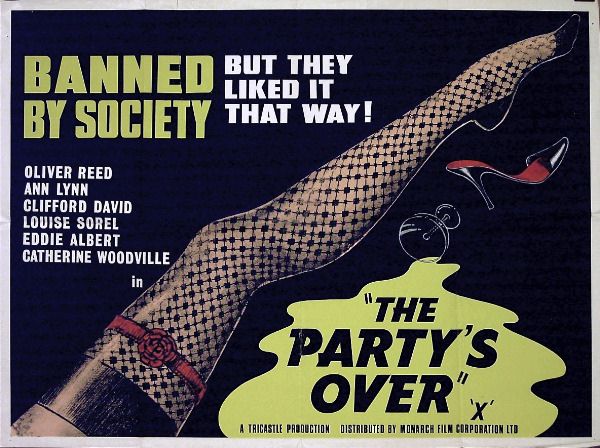
Objectification As Desire In The 1960s British Youth Film.

On a recent exploration of several films from the 1960s, some startling realisations occurred.  A change in moral values is pretty easy to distinguish within any given time-frame but the casual representation of the era’s moral values were surprising to behold.  In the 1960s, the concept of the teenager was barely a decade old; a new refreshing lease of life for a generation of people but … Continue reading Objectification As Desire In The 1960s British Youth Film.