

‘There is a spectre inside every photograph.’
– Deborah Levy, The Man Who Saw Everything
Haunting
I am haunted by Polaroids. After I have taken one, I feel I have bottled something. Under my bed is a box in which I store them. It is sealed tight with a stone atop to keep the spirits locked inside. At night, I swear I sometimes hear the sounds of their moments coming back to life once more. Their miniature worlds start up as soon as we stop looking. Polaroids are ghostly witnesses to our lives, and they possess me with their myriad possibilities.
…
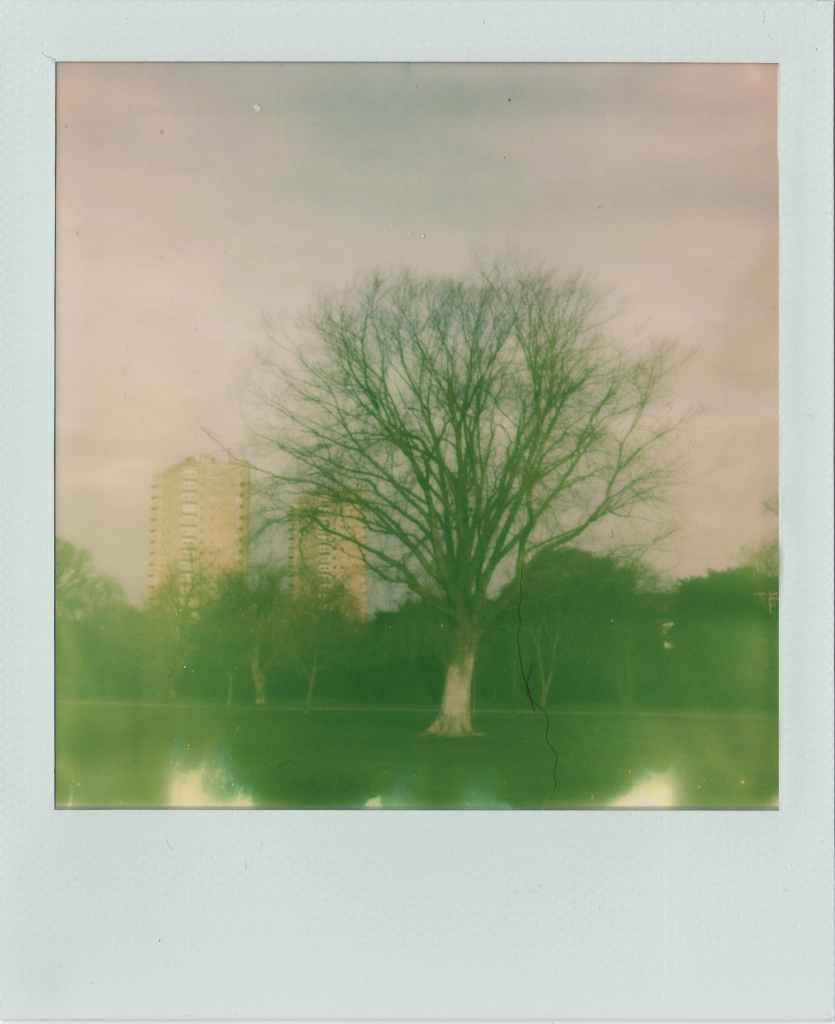
The first thing I ever took a Polaroid of was a tree. That tree was in the gardens of the Anglican Cathedral in Liverpool, the city where I lived for the first two decades or so of my life. It was a dreary day, and the stone of the cathedral had been darkened by persistent rain; hardly ideal conditions to try out a new camera.
I aimed the Polaroid camera with clumsy impatience. Time was blinded by its flash and swallowed greedily by the strange machine. Metal teeth whirred and chewed, eventually grinding out its first small image. It was a permanent memorial to the dead seconds accruing endlessly beyond it, but not much else.
The noise of my camera had made me feel conspicuous in the quiet space that day. Its stark flash, so much a part of the character of instant cameras, had lit the surroundings with a harsh light which seemed to ricochet off the high sandstone walls. I half expected the occult glow to reveal shadowy silhouettes of figures unseen with the naked eye. It revealed, in fact, very little.
In those few seconds afterwards, my picture of the ominous tree was quickly harvesting meaning. By existing in the very space and time it was charged with documenting, the photograph had gained something else, some presence. All Polaroids have this unspeakable feeling of company, whether they are good photographs or not.
You are never alone when looking at a Polaroid.
I watched the photo develop quickly; a pale recreation of what stood in front of me fading lazily into being. It felt as if I had grabbed the blank image, pushed it against reality, and peeled it away to reveal a wet imprint of its likeness. Reality is soaked with living time and Polaroids absorb it like a sponge.
I wanted to take another photo, this time of the looming cathedral itself. Anyone who takes Polaroid images knows how addictive and exciting it quickly becomes; before, that is, the inevitable cost of modern-day stock is remembered. Then another idea came to me, a common one when initially exploring Polaroid photography. Instead of the cathedral, I wanted my second Polaroid to be a photo of my first.
In his short film Engram (1987), Japanese experimental film director Toshio Matsumoto was similarly excited by these different viewing screens onto the world. In his ten minute film, he explores the possibilities offered by the Polaroid of folding reality in upon itself, lining up instant images with their subjects.

Whole worlds become animated in his images, as if life has frozen everywhere except within his photos. Reality and its recreation sit side-by-side until one feels more alive than the other. It is an inversion of what really happens when we photograph things. Yet it also feels exactly what happens when looking at the images we make with Polaroid cameras.
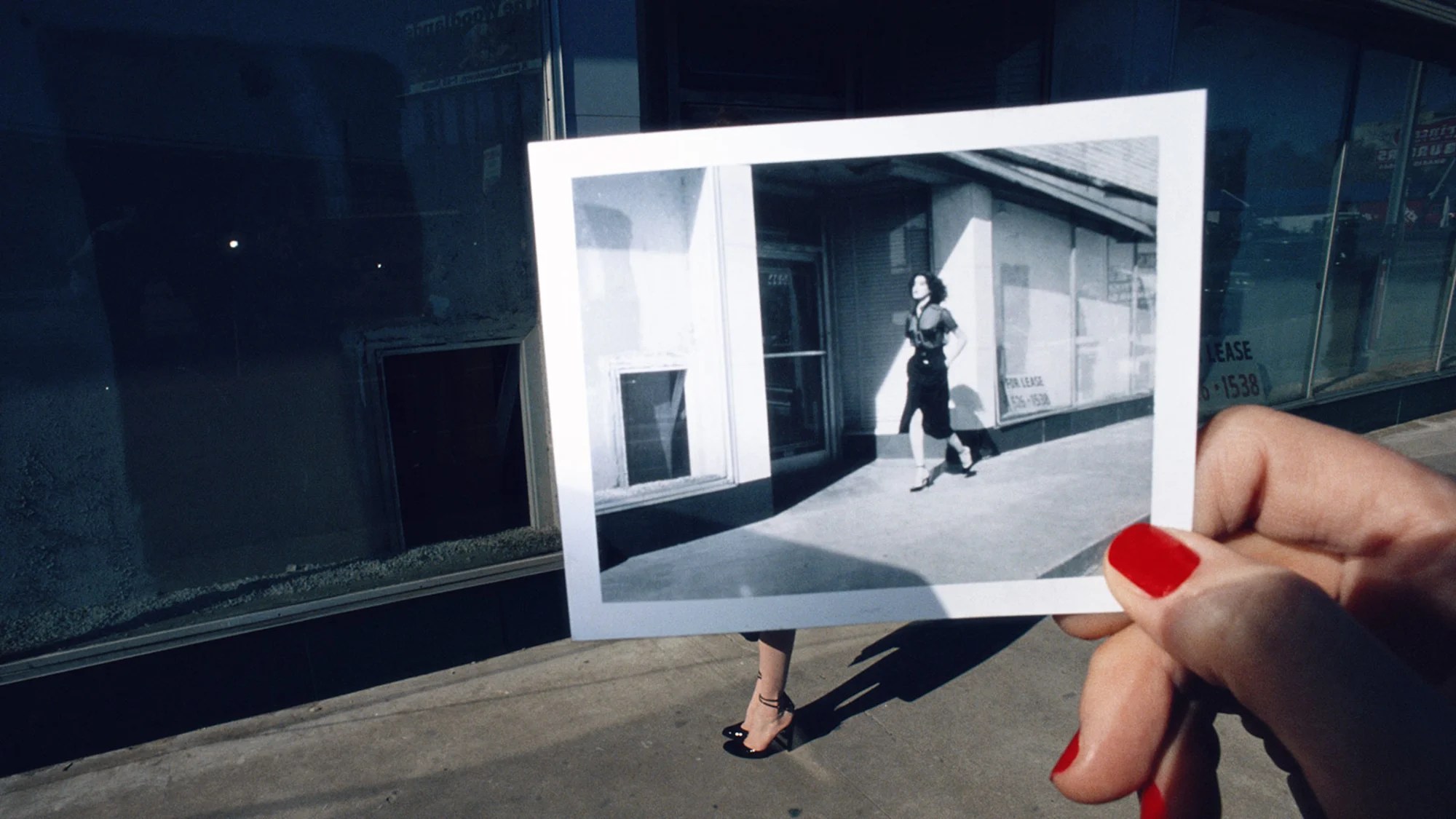
Matsumoto was far from being the only artist to layer time and space with Polaroids, or embrace the Mise en Abyme as the French call it. Fashion photographer Guy Bourdin did much the same thing for various photoshoots for Vogue Magazine. In one series of photos, he plays with the idea of showing time passing and a disjoint between connected moments using layered Polaroid images.
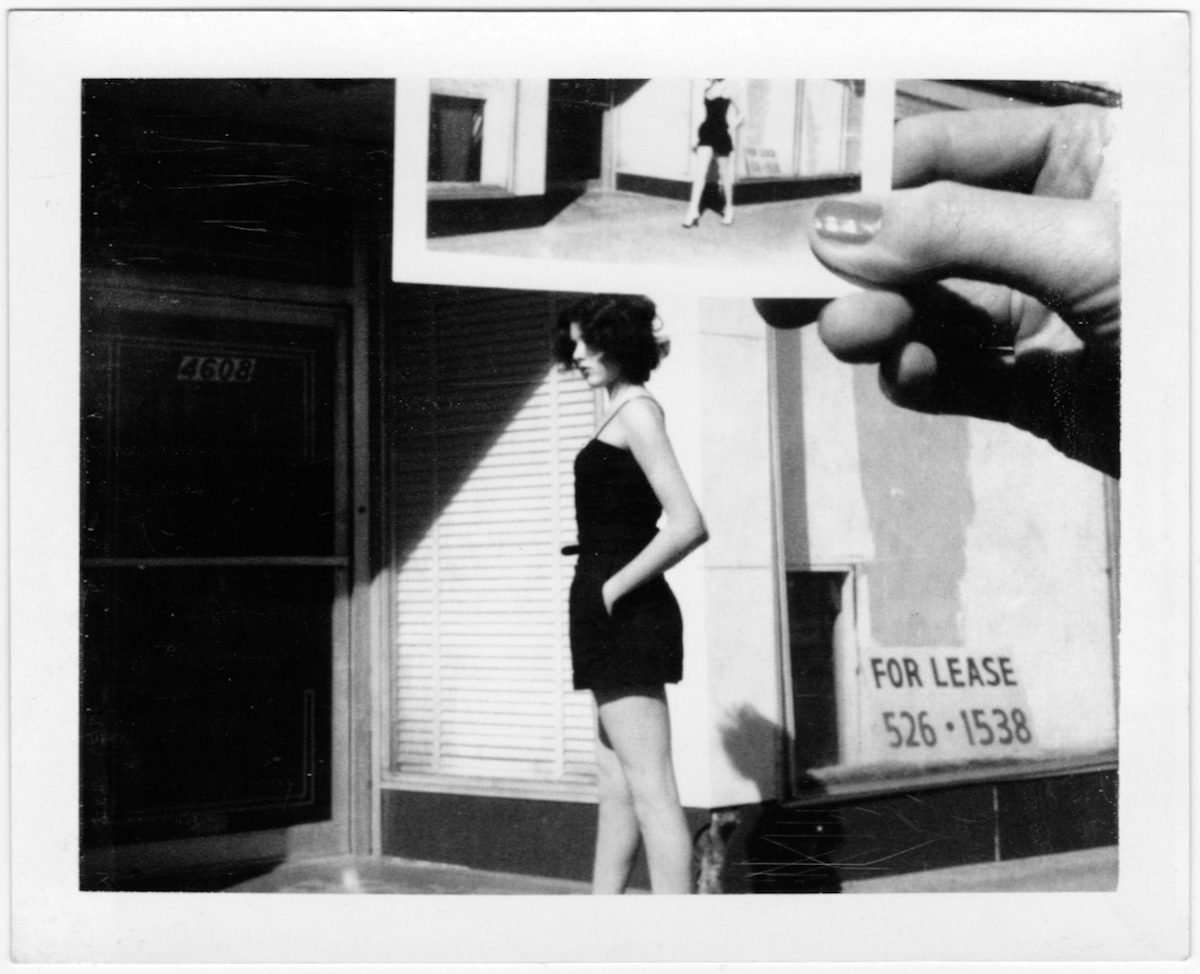
There is tension in such experiments, even if, in this case, merely practice Polaroids before the full film shoot in aid of Charles Joudan’s Spring 1978 collection with regular Bourdin model Nicolle Meyer. Dimensions were folded inward, rubbing up against each other. The simulation of reality almost breaks. Bourdin split the world in search of beauty, splicing moments together that should never have existed in such close paradox. There is a reason why they call it Mise en Abyme.
A Place in the Abyss.
The moment passes, time moves on. Meyer, Bourdin’s muse in this period, is bored and stops in the 35mm moment. Bourdin acknowledged the dead time between the photos, hiding the present of his 35mm now with a Polaroid then. Meyer walks from the past into Bourdin’s present, though it is only her feet we see, uniformly prim in Jourdan’s classic Raven Ankle heels as she is hidden behind time regained.
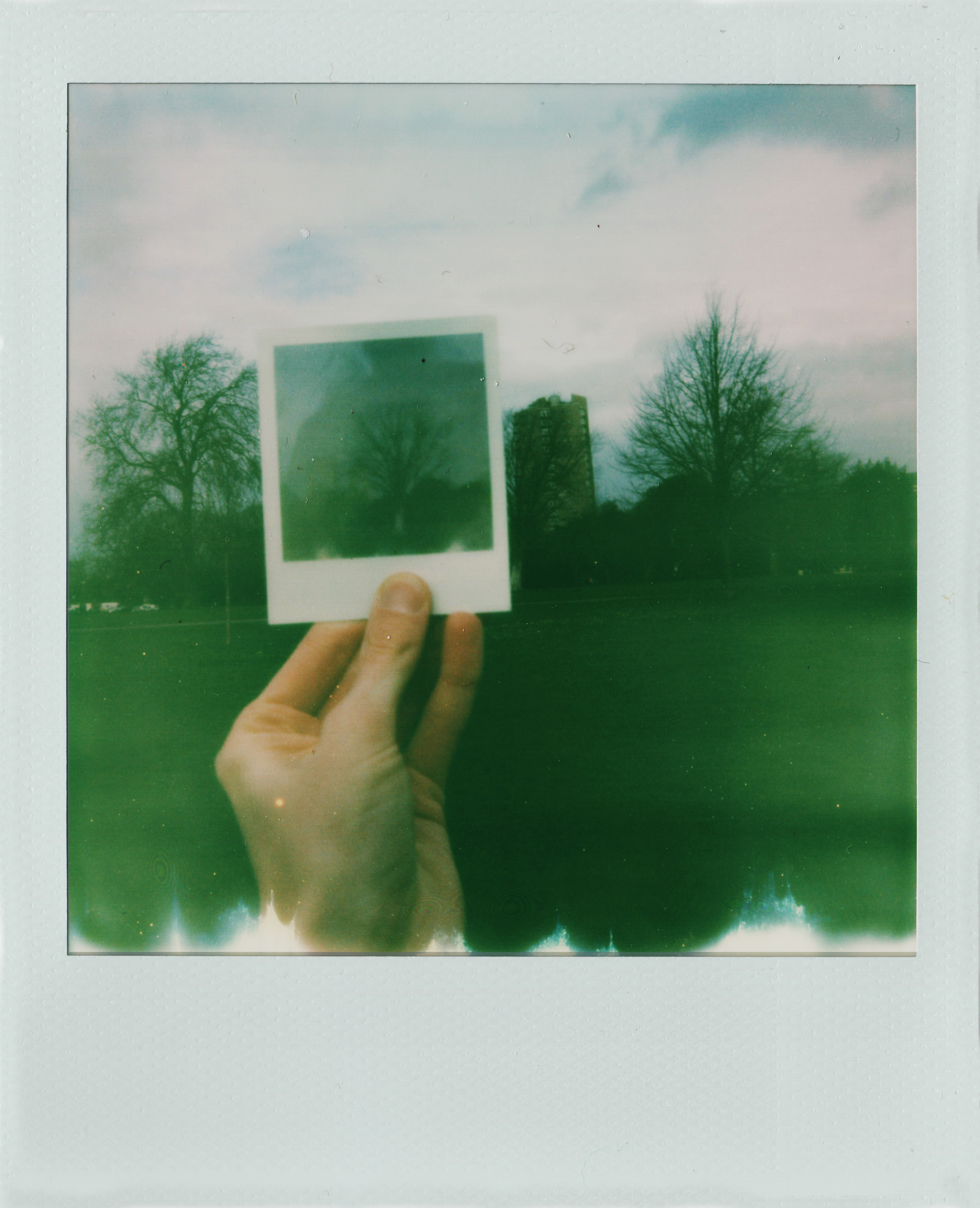
Like in Matsumoto’s film and Bourdin’s fashion shoots, I held my small, badly composed photograph until it slotted back into the reality of the Anglican Cathedral Gardens. It was a jigsaw piece taken out of the world and put back in its rightful place. The camera flashed again and produced a barely perceptible image of a rectangle within a rectangle, gripped by my bony fingers.
It was a terrible photo.
In spite of this, when I looked at the photos later, the whole moment flooded back. In its moment of creation, it had become a part of what was captured. It was the amber around an insect, the ghost in the grain. The abyss, cut and dried.
My pair of Polaroids felt endless, like rooms with opposing mirrors. They could have been objects found in the stories of the Argentinean writer Jorge Luis Borges in their insinuation of the infinite.
Borges is a recurring figure in photographic writing due to imbuing everyday objects with photography’s same potential towards an implied forever. If photography had somehow required inventing in Borges’ age, only his gradual loss of sight would have likely prevented him from creating it himself.
My Polaroids felt like The Book of Sand, a tome from Borges’ short story of the same title which has infinite pages. So daunting is the object that the initial decision to destroy it by the story’s narrator seems perfectly reasonable. The fear of the infinite comes from its power to flood reality; the Place in the Abyss could swallow all.
In the case of Borges’ story, it is a specific fear of fire and smoke that troubles the narrator, The Book of Sand possibly catching alight until the world chokes on the fumes of its burning pages. Would my Polaroid-within-a-Polaroid burn forever with its trapped worlds and moments? It is a melodramatic idea and, of course, not true. But there is something in the form does speak to this fantastical ideal. The ghostly world within feels whole enough to match our own.
Even using that lesser camera to take those photos in the graveyard gardens – a flawed model creating a much smaller form of Polaroid rather than the traditional format, more like the size of a business card – it was clear that the Polaroid camera provided an unusual charge to its images. It has the ability to examine familiar photographic themes, but with a distinct tangibility.
Polaroid photos realise in very real terms what the writer Gaston Bachelard believes regarding poetic images of the mind. ‘Only images’ he writes, ‘can set verbs in motion again.’ The Polaroid reignites our lived moments so powerfully that it is not inconceivable that the world lives on in their grain, and will continue to do so after we are gone.
…
I cannot recall the drive behind my desire in wanting a Polaroid camera. Certainly, an obsession with the films of Russian director Andrei Tarkovsky and German director Wim Wenders helped; both having beautifully applied their cinematic eye to Polaroid photography in between making their films. But my interest was driven as much by how the camera seemed an occult device. It is still, to my mind, an analogue Ouija board of sorts, threatening to summon back the dead.
Polaroid photos are time machines, graves, evidence, portals, memories, regrets and everything else that a photograph can be, just with the colours of our world uniquely haunted by presence. It is the machine’s askance of us to look at the moments of our lives passing in such a literal manner that most fascinates me. The ordinary, the Polaroid implies, is almost always extraordinary when doused with instant photographic hindsight. What we lose is ultimately always of interest.
Polaroid photography’s instantaneity is not a simple foreshadow of the accelerated immediacy of our modern digital world as it is sometimes characterised. It is something entirely of itself, unique in its ability to meld analogue and digital habits. Instantaneous does not, of course, exist in any form of photography. As the critic and photographer Teju Cole believes, there is no real possibility of such a state. ‘There are no instantaneous photographs:’ he rightfully argues, ‘each must be exposed for a length of time, no matter how brief.’
It is the sheer determination on the photograph’s part to exist as close as is possible to reality that makes the Polaroid interesting. It may be only instantaneous in marketing terms, but it is as close as it gets in terms of physical photography. In more basic terms, it occupies the same scenes from the film of our ongoing lives rather than the exact frame of the reel (though an exact frame is ultimately what we are left with).
The Polaroid is different from other photographs because we experience the process of time’s fragmenting quite literally. Seeing becomes séance.
Roland Barthes, another philosopher with much to say regarding photography, writes in his celebrated Camera Lucida that photographs reproduce something singular but infinitely. ‘What the Photograph reproduces to infinity has occurred only once’, he writes, ‘the photograph mechanically repeats what could never be repeated existentially.’ But what does the Polaroid have to say about this, when it is actively part of what is happening in the moment, or at least as close to it as possible?
How could such an idea account for a form that regularly bares scribbles written upon its boarder, or is stained with coffee from the café it is taken in, or reveals faded colours that started to lessen under the strain of the same sunlight we can see in its image?
This is something that deserves greater attention than it ultimately received in Barthes’ book, which reduces Polaroid photography down to just a single thought: ‘fun but disappointing, except when a great photographer is involved’. Is a photograph, one that lives and ages with us like no other kind of photograph, really just a fun but ultimately unfulfilling gimmick? The whispering voices from the box under my bed suggest otherwise.
…
Ironically, I never kept my first Polaroids of the tree. My initial camera failed to produce those iconic square images with their distinctive boarders. My photos also lacked the memory-drenched colours that I wanted to lock my present within. They ended up in the bin with an acute sense of regret.
Instead, the photos from my camera fitted uniquely and depressingly into Barthes’ summation of tawdry disappointment. I recall now my frustration with the bulky, plastic machine from the moment I bought it, naively believing that Polaroids such as those by Tarkovsky and Wenders were inherent to the camera rather than in the skill of the photographer. I was painfully wrong.
The noted 35mm photographer Walker Evans famously described the Polaroid camera as being like a toy. Though I believe him too blasé in his assessment – his own Polaroid photographs are devastating proof of this misjudgement – my first camera did indeed resemble nothing less than a Fisher Price toy. It was brightly coloured and awkwardly shaped, with no freedom to adjust its settings; a literal ‘look and shoot’ contraption that had been seemingly designed for a child. It was, at least, the embodiment of Polaroid’s own advertisements which often suggested its unique selling point to be how simple it was to use.

In spite of this simplicity, I recall how much potential was still detectable in just those small, poor quality photographs. They were the same sort I had seen on various walls in the flats of friends, telling of dark parties and all-nighters littered with deathly white but happy faces, their thin white boarders stained with questionable substances.
Even with photography existing to some degree in the past tense, it still astonishes me how the aesthetic of the Polaroid heightens its role as a document of memory, cascading its subjects into some abstract past, feeling far from the era they are produced in. And all this is done while being defiantly of the moment.
You can be nostalgic for the present with a Polaroid camera. There are few photograph forms that are so brazenly contradictory.
With my discarding of those initial photographs of the Anglican Cathedral’s gardens, it felt right to try and re-illustrate the point with a better camera. The result was a pale Polaroid of a tree near where I lived in South London at the time. The day was dryer than that first lonely wander to the damp Liverpool graveyard several years before. The point I wanted to prove, however, was the same.
The first photo developed as I sat on a bench watching BMX riders zoom round a nearby track. The screech of their brakes is contained in this photograph for me. Then came the challenge once more: to slot that moment back into the world and photograph it.
The camera fired again, the photo printed and slowly developed. It felt like a window onto another reality, a layering of worlds and times, moments and memories. Even if you cannot see it, something living is in attendance: the presence of that day. The photo is haunted by experience.
All Polaroids are haunted by their photographer’s subjectivity.
In taking those first two images, it was clear that something more interesting was happening than just the capture of a tree in Liverpool. In taking those second two images, I confirmed my own desire to continue messily experimenting with this medium.
Those photos did not need to be aesthetically pleasing or accomplished. They were profound witnesses to my own personal experience that only I shared in its fullest flavour; folds in space and time that, even with my terrible photographic eye, conveyed something with startling power.
This book chronicles the search for that something.
 Celluloid Wicker Man
Great writing. Sorry this wasn’t picked up by a publisher.
Thank you so much Terry! Means a lot coming from you as you’re my ideal reader! A.
This is good. Would make a great series of pamphlets or a chapbook.
Thank you 🙂 It’s a full 80,000 word book, I’m just posting it all here gradually as I’ve given up trying to sell it to a publisher haha.
Yes a bit long for a chapbook. As much as I like them 😊. Look forward to upcoming instalments.