
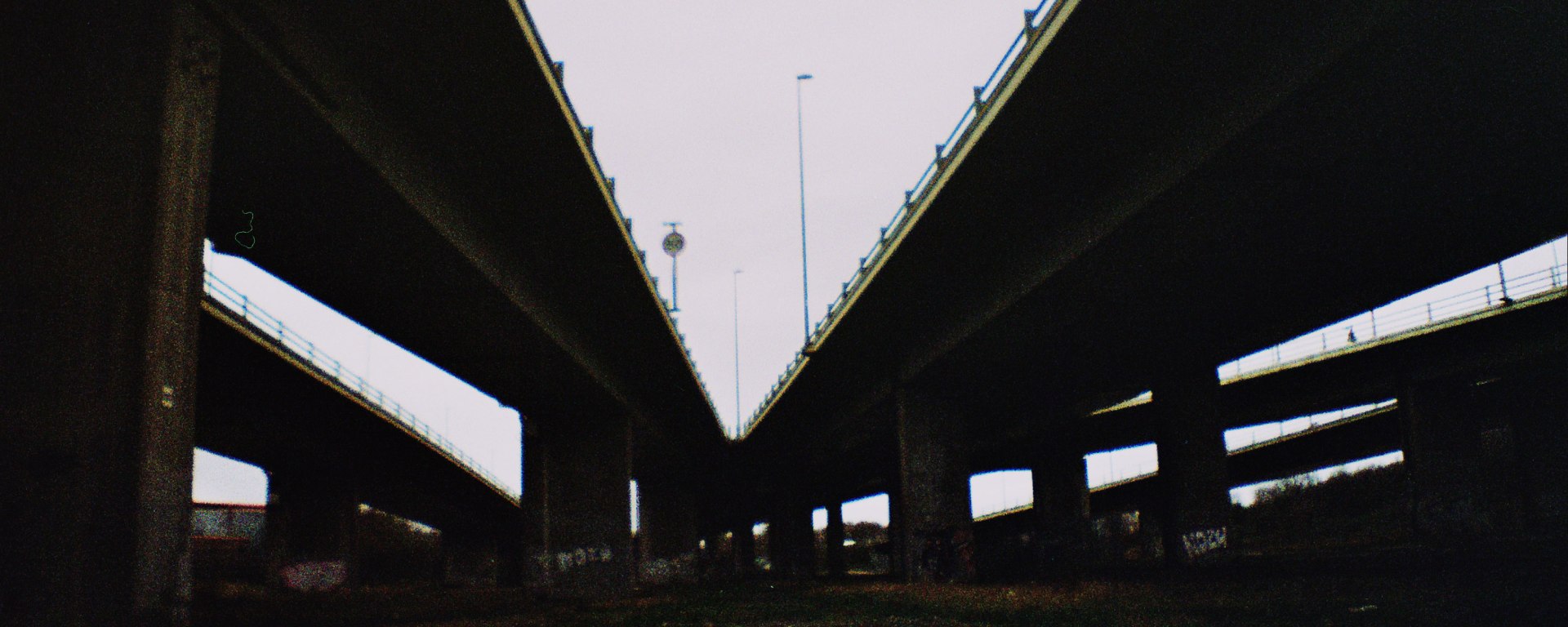
Somewhere in this nexus of concrete and structural steel, this elaborately signalled landscape of traffic indicators and feeder roads, status and consumer goods, Vaughan moved like a messenger in his car… – Crash (1973), J.G. Ballard
In the dead space before Christmas 2015, I found myself meandering back towards my old secondary school on The Wirral peninsula, one of only two things that I still have nightmares about. It was not the school that was my destination but the area that surrounds it which, for me, defines a very particular form of edgeland and reminds of a very personal solace.
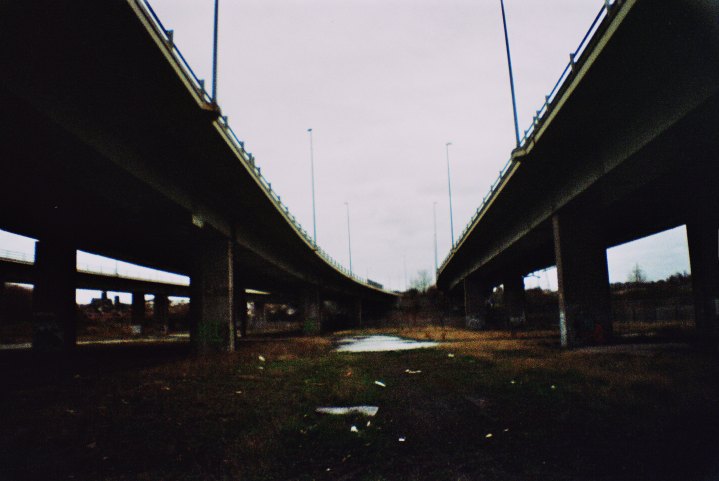
Walking along Mosslands Drive in Wallasey, an unnervingly straight suburban road whose name and history implies an aptly boggy transience, I began to have flashbacks of what this journey meant to a younger version of myself; forever on the look-out like a preyed-upon herbivore from the more aggressive variety of peers prevalent in my memory of the area; all keys, chains and Stanley knives.
It was fear that often drove me into concrete area in question, albeit rebelliously as it was strictly ordained by various teachers in the school that it was dangerously out-of-bounds and punishable by detention if caught beyond its frontier. Ironically, it felt safer than the rather flexible boundary of the school with its host of violent young men.
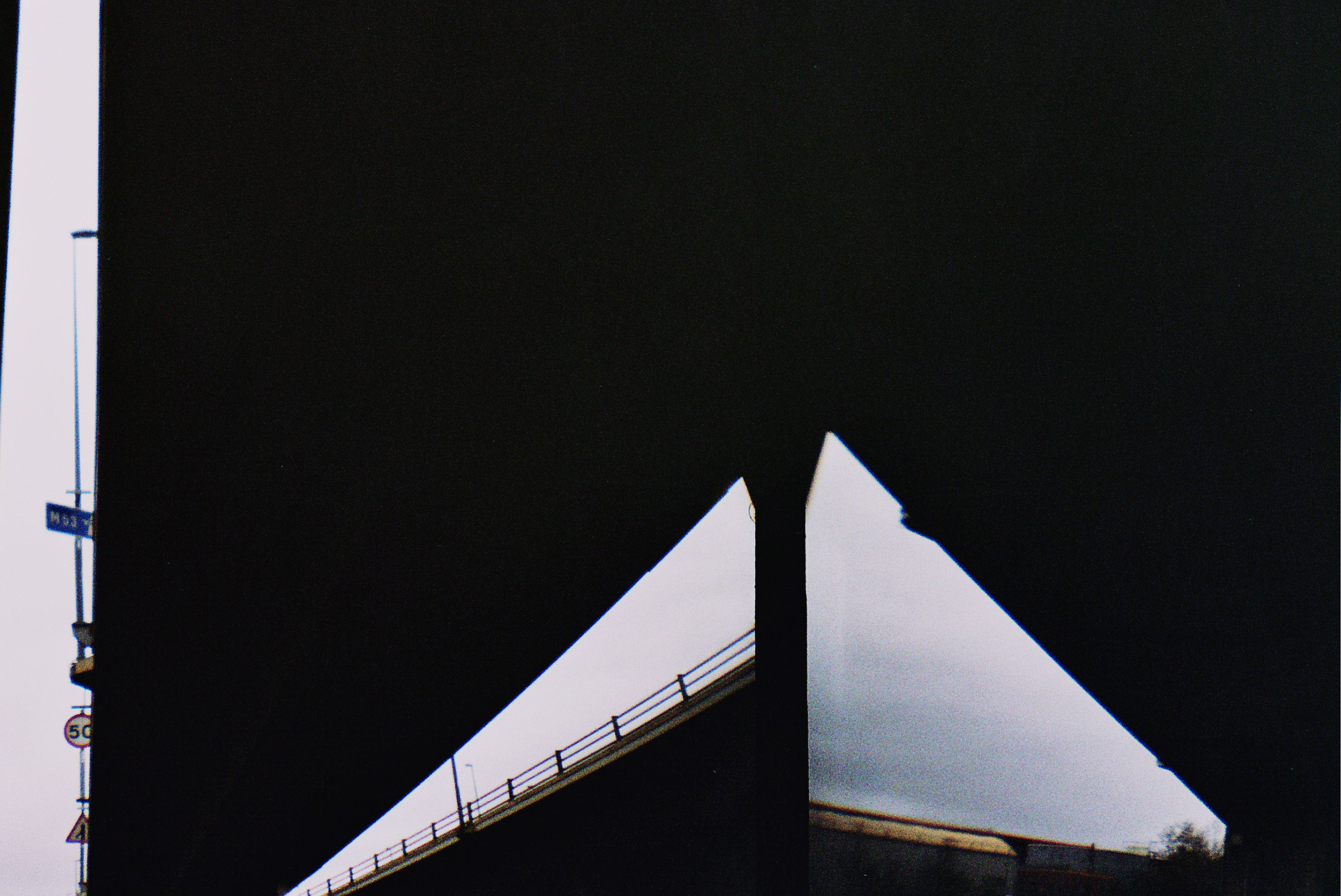
The place in question follows a footpath initially parallel to the school that provides the strange Ballardian privilege of walking alongside (and then directly underneath) a motorway, the M53 to be precise. This gives rise to an intensely dangerous feeling due to the speeds at which the passing cars hurtle by. The vision of one flying over the edge and towards the walker on the pathway is believable and constant as the noise made from each vehicle’s passing is so tremendous.
The New Brighton to Liverpool train also runs underneath the motorway as it stretches out into its various lanes, adding to the screaming white noise. As the path unwinds, it curves inwards and the walker is taken directly underneath the first slip-road of the motorway. The noise at this point is always dizzying. Waiting for a passing train is essential for the desired woozy effect of standing within the arteries of both train and motor routes, like a transport synapse in the middle of a paraphrenic collapse.
If anything, it feels like the blood-rush before a fainting spell. Perhaps it is, in fact, what extinction itself actually sounds like – a motorised vibration rising to the point of an unstoppable expiration. ‘The traffic drummed over his head, no more than twenty feet away, an unceasing medley of horns and engines’ as J.G. Ballard writes in his novel, Concrete Island (1974).
At this point, the adjacent underworld beyond seems at first impenetrable due to the spiked, razor-wired fences that protect the train-track. This illusion is broken when walking further on to meet a brutalist bridge which crosses the railway lines and, in the opposite direction, the growing pools of murky water that lead to the radioactive greenery of Bidston Moss.
The area itself, especially when seen from the train on its way towards Birkenhead and Liverpool, allows sights of these submerged areas and railway tracks, recalling The Zone from Andrei Tarkovsky’s Stalker (1979); all submerged train-tracks, overgrown fences and debris-littered edgelands. A feeling of distance arises from these artefacts, left by a more industrious, unsparing age, though created without the aid of a crashed meteorite and its subsequent fallout as in Tarkovsky’s film. Laziness was its only catalyst for creation.
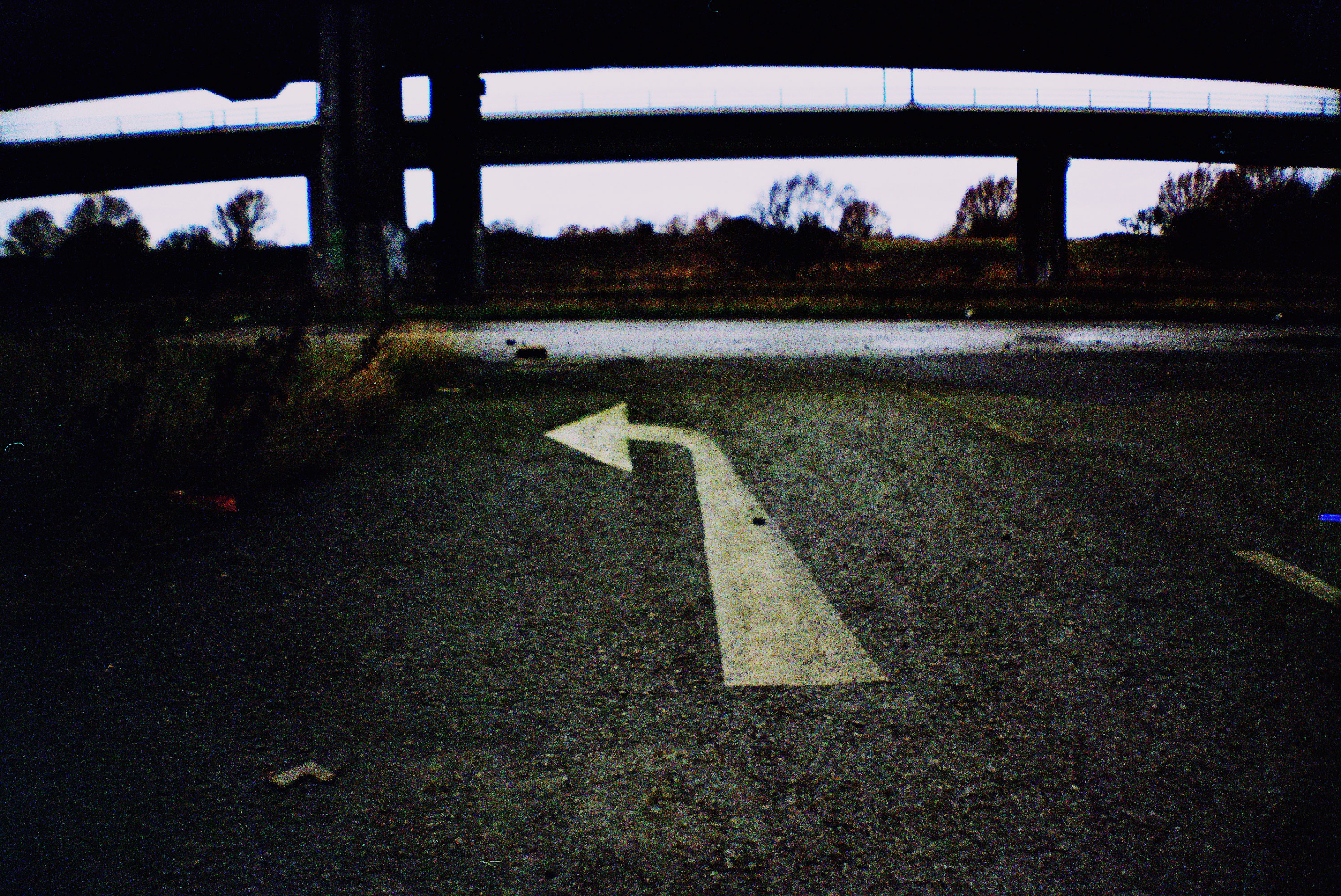
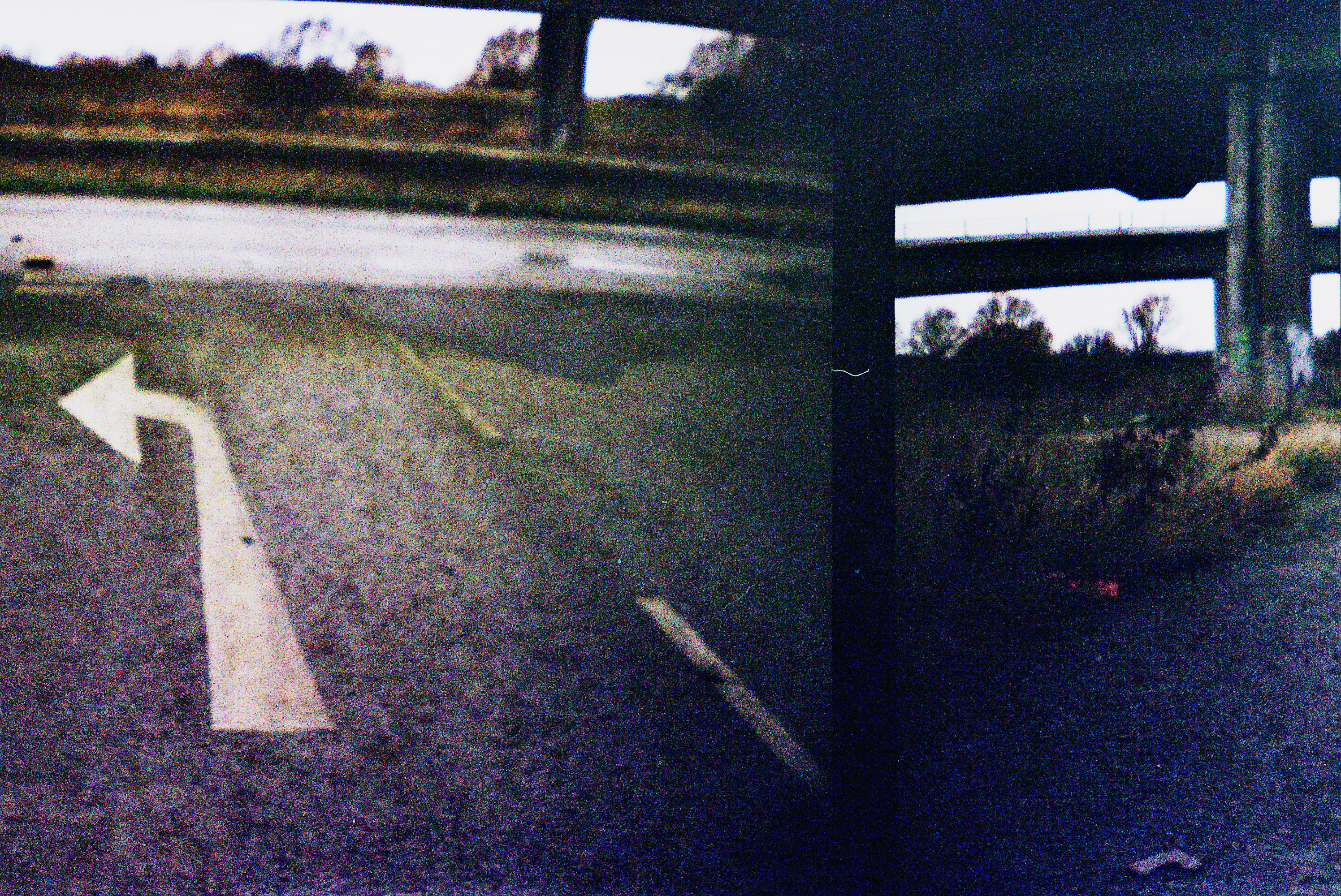
Straight ahead lies a semi-functional business complex ruled over by the DIY warehouse, B&Q, but it is almost entirely hidden by rustling shrubbery of various forms, adding an amusing impression of desired secrecy to the building. Trudging through a brief mire of mud and rubbish leads to what looks like a graveyard of roads. The layout of a ghost road is still remarkably defined; Or, as Ballard describes his own similar landscapes, ‘The damp earth was dark with waste oil leaking from the piles of refuse and broken metal drums on the far side of the fence.’ It may as well have had further signs detailing ‘Please give way, oncoming spectres.’ These were Ballard’s ghosts as well as my own.
Ballard wrote Concrete Island as a response to both his own fetishisms growing around cars and consumerism, and how this new merging of materialism and sexuality had affected the topography of the outer London motorways. It follows a man trapped in a space such as this, detailing his growing adaptation to the landscape. I failed to find the punk and tramp inhabitants that Ballard’s own Robinson Crusoe, James Maitland, finds under the Westway, yet both could equally be sustained by this Northern equivalent.
Ballard himself suggests the ubiquity of these types of spaces in the 1994 introduction he penned for the book:
As we drive across a motorway intersection, through the elaborately signalled landscape that seems to anticipate every possible hazard, we glimpse triangles of waste ground screened off by a steep embankment.
It begs the question as to why they rarely appear in wider British culture. Are they not worthy of creative interest?
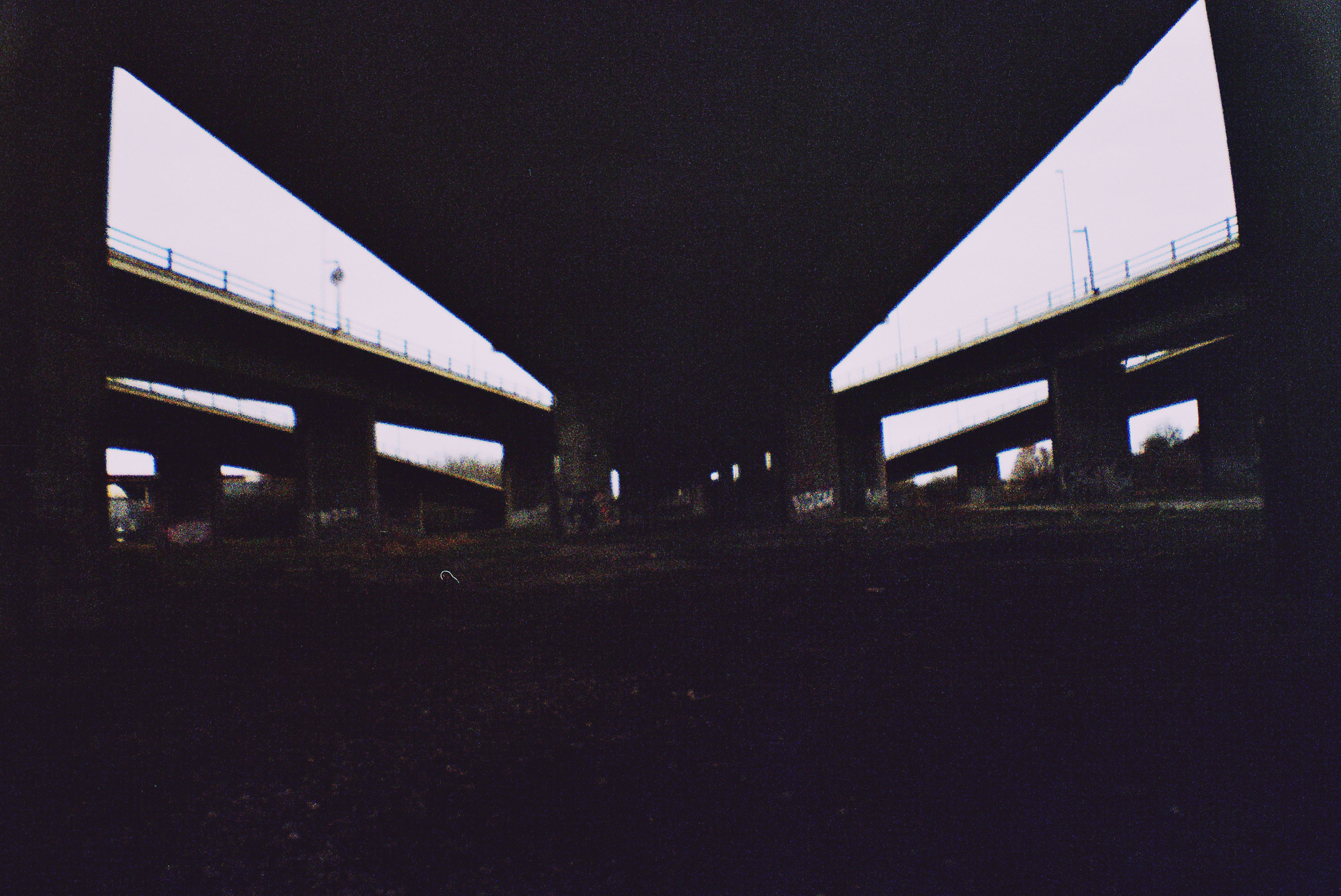
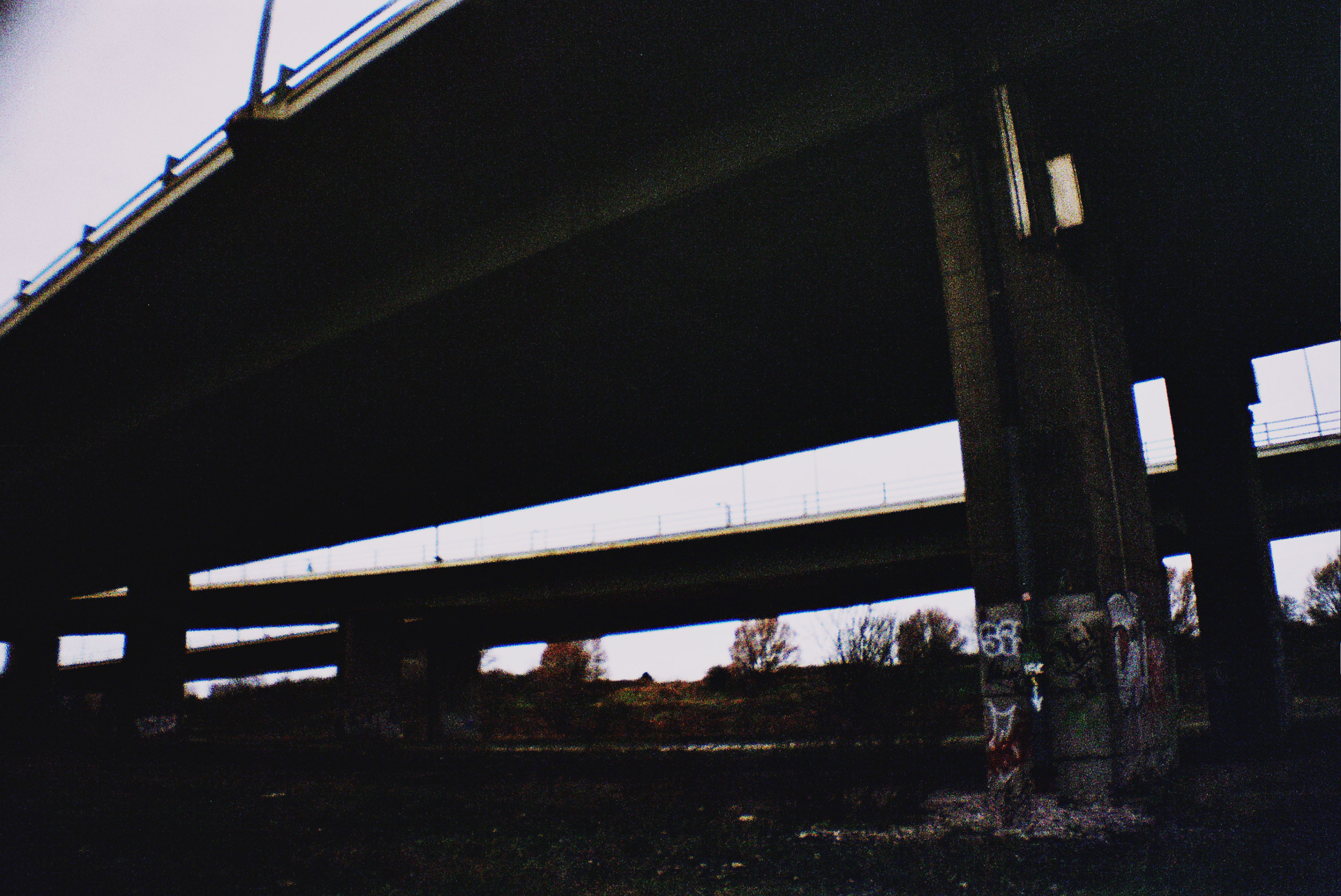
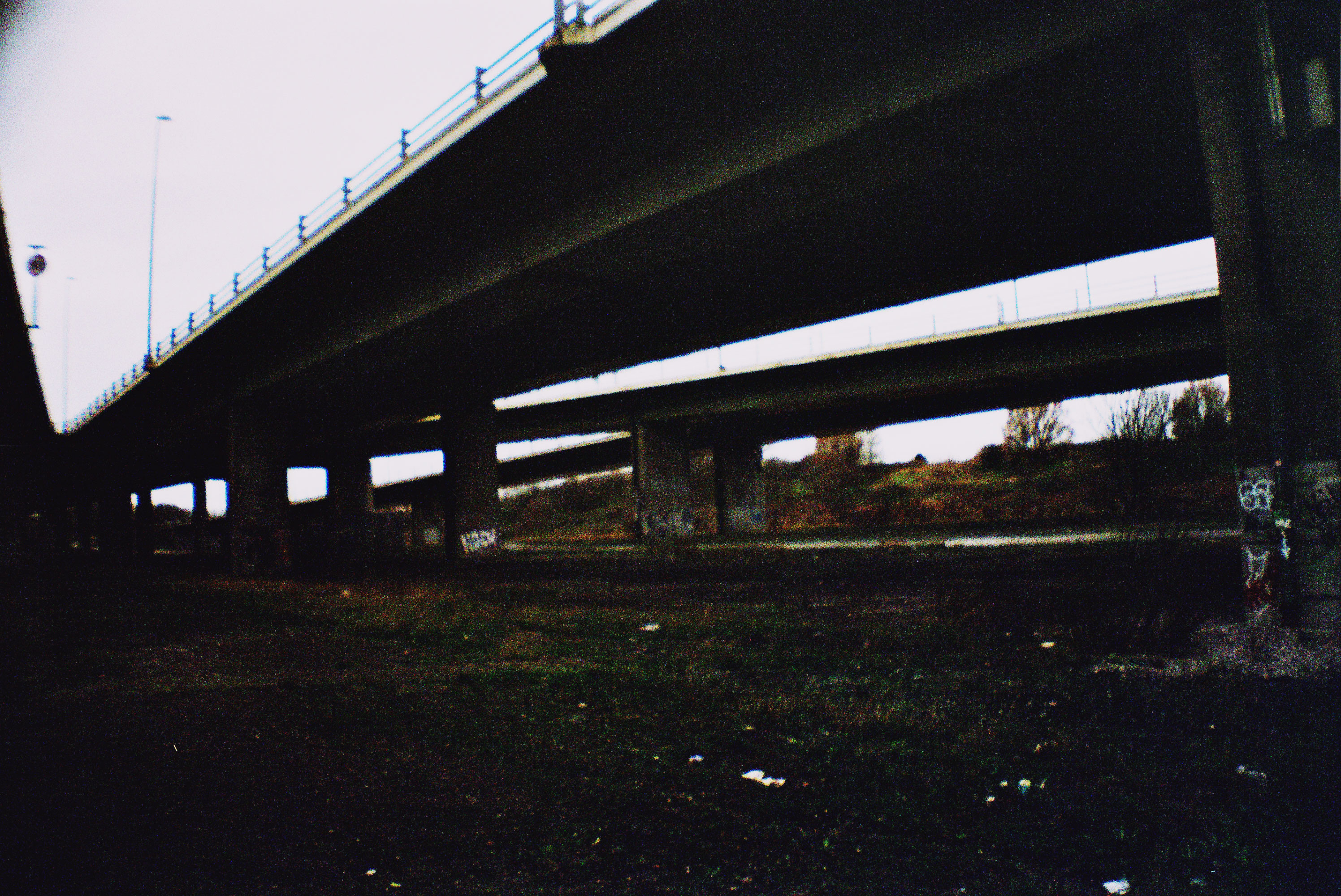
The many pillars, which when perceived from lower levels look like forms of uncompromising menhir, are scrawled with colourful graffiti. The whole cavern feels like a theological site designed for unspeakable rites; its emptiness was in juxtaposition to the feeling of its almost constant but unseen use above.
This is heightened further by the level of debris scattered around like the remnants of an invisible warzone. ‘Below the overpass, at the eastern end of the island, a wire-mesh fence sealed off the triangle of waste ground from the area beyond, which had become an unofficial municipal dump’, as Ballard describes it.
The motorway’s various slip-lanes rise together until the only patch of sky available is a small, thin sliver that is itself dominated by views of the paranoid signage reminding the drivers of all of the rules and regulations which may (or may not) prevent them from becoming pulp on the concrete and mud below.
The space feels both grimy and antiseptic because of its cold, silvery light. The contrast finds a visual cue in the various medicinal litter germinating in between the healing leaves of dock.
I cannot mourn for whatever pristine rural landscape once lay where the motorway now sits obtusely. The walk under the M53 and into its various caverns always produces a huge range of excitements and impressions, but some ineffable sadness does permeate the space; a punctured commercial zone, typical in its production of a natural detritus that forces all around it to adapt or perish under its blanket of concrete. As Ballard suggests in an article for issue six of the magazine, Interzone (1987), ‘Homo sapiens has won his intelligence from the ordeal of surviving an extremely hostile environment.’ In this vein, my visit brought back one final memory which tied into this sense of survival.
On walking back with my father from the area some years ago, we came across an extremely angry looking purple caterpillar of the puss moth. This caterpillar is a daunting and surprisingly aggressive larvae, blessed with what looks like the face of a high-level bureaucrat and a whipcord double tail, spending most of its life as a shade of neon green before turning a virulent purple when ready to pupate.
We took it back home and, learning that it built its own cocoon from bits of wood, it was supplied with various twigs with which it constructed a suitably Modernist housing to metamorphose within. For months afterwards I waited to see the moth emerge, famous for its bulky size and intensely fluffy persona. Some time later, after another walk back from the M53 zone, I arrived home to find the wooden cocoon open but, in place of the glam-rock moth, stood a huge parasitic wasp.
The caterpillar had been a living incubator and food supply for the wasp’s own larvae. We failed to identify it, as did the entomological department at the Museum of Liverpool, but it seemed an apt conclusion for something lifted from such a space; unforgiving just like the road by which its mother first laid her eggs within the caterpillar’s body.
I sometimes wish my earlier memories of this landscape would equally burst out from my own body and simply leave. But, every time I revisit, I am the glad the graffitied, concrete parasites of my own unhappiness are carried inside me, even if to ground me. The motorway spares no illusions as to the nature of being alive.


 Celluloid Wicker Man
Great stuff and intriguing story about the caterpillar/wasp!
Thanks!