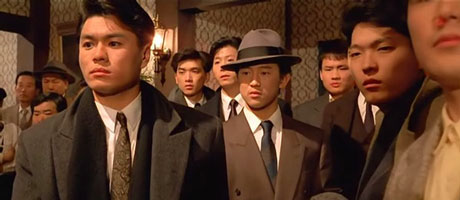
Chi-hwa-seon (2002) – Im Kwon-Taek.

The preservation and evolution of South Korean cultural traditions became the dominant focus of Im Kwon-Taek’s films after the ease of censorship in a change of government regime.  A number of his post-genre cinema began to address this though the real cultural reactions can be found in later work which can effectively be called post-Cannes; meaning the cinema he made during his currently slow but … Continue reading Chi-hwa-seon (2002) – Im Kwon-Taek.

Andrei Tarkovsky – Polaroids, Mementos and Time

Some directors are very natural auteurs. Their films always seemingly a product of their own conception which seems unavoidable to visually mistake. Viewing all of Andrei Tarkovsky’s films, this is perhaps clearer to see than in the case of most other directors. His distinctive visual style, which morphs into several similar variations, is instantly recognisable. Dripping with faded lights, distinct textures and elemental forces, his … Continue reading Andrei Tarkovsky – Polaroids, Mementos and Time

Festival (1996) and the Acceptance of Loss – Im Kwon-Taek.

Celebrating loss can be a difficult task even for the more optimistic of personas.  The idea of someone being physically and emotionally lost is not a pleasant experience which, at best can provide some cathartic character building in between the tears and complete incomprehension as to what exactly it means to live or die.  It’s a theme familiar in many filmmaker’s auteur driven, thematic catalogues, … Continue reading Festival (1996) and the Acceptance of Loss – Im Kwon-Taek.

The Red Shoes (Powell & Pressburger) – Visual Forms of Diegesis.

The audio-visual theory of diegesis probably does have some form of basic, traditional film theory equivalent.  The splitting of film sound into what the characters and the audience can hear and the differences and problems this can cause are the basis for so much, often excessive, film sound theory.  For a film such as Michael Powell and Ernest Pressburger’s The Red Shoes (1948), the audio … Continue reading The Red Shoes (Powell & Pressburger) – Visual Forms of Diegesis.

Winstanley (Kevin Brownlow and Andrew Mollo) – Landscape Politics and Folk Aesthetics.

Though more famous and widely recognised for film restoration and archiving (for which he received an Academy Award for) Kevin Brownlow’s second shared feature film with Andrew Mollo, Winstanley (1975), is a masterpiece of traditional, historic cinema.  It not only captures the feel of the era that produced an amalgamation of tradition-based horror cinema but showed that, through using a number of classical cinematic techniques, … Continue reading Winstanley (Kevin Brownlow and Andrew Mollo) – Landscape Politics and Folk Aesthetics.

Hidden (2005) And The Mysteries of VHS Aesthetics – Michael Haneke

It hasn’t taken long for the medium of VHS to enter the realm of retrograde chic.  During the 2010 Liverpool Biennal Contemporary Arts festival, one of the main pieces that stood out was actually an independent sculpture made entirely for VHS cassettes; spools of tape spilling out onto the floor while Videodrome-like screens played fuzzy images of recorded images.  The medium now occupies that same … Continue reading Hidden (2005) And The Mysteries of VHS Aesthetics – Michael Haneke

John Ford And The Visual Representation Of Emotion And Belief – (The Searchers, Stagecoach and Fort Apache)

John Ford is such an obvious enigma; it’s not surprising that the new wave of American film makers became obsessed with his methods and persona.  The awkwardness that exudes from the famously sparse interview with Peter Bogdanovich highlights well the portrayal of relationships in Ford’s films; namely that behind a blunt, entertaining simplicity, there’s an array of intelligence and complexity just waiting to be found.  … Continue reading John Ford And The Visual Representation Of Emotion And Belief – (The Searchers, Stagecoach and Fort Apache)

Derek Jarman And The Music Video.

The constructs that delineate a difference between short films and music videos has been fuelled by debate and value judgements by those after a perfect set of rules.  Acclaimed director Derek Jarman didn’t seem too fussed about these connotations when creating his short films and music videos often blurring the line between the two and questioning whether the line even existed through explicit highlighting of … Continue reading Derek Jarman And The Music Video.

Musical Emphasis on Visual Words (François Truffaut and Pier Paolo Pasolini)

The relationship between sound and vision in film is one that is complex and almost indefinable in a broad sense due to each director and composer treating such relationship in different ways.  The two examples about to be discussed are almost reverse images of each other’s effects; the same method has been applied but for different reasons and different results.  Much examination has taken place … Continue reading Musical Emphasis on Visual Words (François Truffaut and Pier Paolo Pasolini)