

Time and again, cinema seems drawn to Polaroid photography, often in unusual and tangential ways. Antonioni’s film, even if ultimately about 35mm photography, is not the only one to explore the strangely tangible qualities of space within photography (or the things contained within a photograph beyond the image).
When looking at Polaroids, we perceive them spatially. By that I mean we have the potential to attain a sense of the world within the photo, even the parts that we cannot see or have never seen. If we look beyond the space seen directly in the square of photographic film, our mind’s eye cannot help but add detail.
Once we are at the frame’s edge, our imagination and memory kicks in. Soon we return to the space, recalling or filling in its details. This is not too difficult as so much general information about the space is already contained within what we can see. It tells us the tones and textures, the light in that moment, the material of the objects around, and so on. It is not too difficult to rebuild what was edited out of the frame, rather like shorthand cheat cards sneakily used in an exam.
Polaroids have a cinematic aura due to their presence in the moment more than anything specifically aesthetic. In fact, the everyday image of a Polaroid creates a pleasing contradiction: there is something more to these objects even if they seem banal and ordinary.
The best example of this that comes to mind occurs in Ridley Scott’s film Blade Runner (1982), a compelling adaptation of Philip K. Dick’s equally masterful ‘Do Androids Dream of Electric Sheep?’
A whole host of strangely prescient predictions are contained within the narrative; from our dehumanising subservience to technology, to the proliferation of branding as a more recognisable signifier of civilisation than actual civilisation itself.
The film follows Deckard (Harrison Ford), a police agent charged with ‘retiring’ rogue replicants, androids so humanlike that they must be destroyed if they break loose in case they rebel against the appalling conditions they are forced to work in. Deckard is brought out of retirement to search for several particular replicants who are on the run in a futuristic San Francisco. By a strange quirk of time passing, the setting is actually, at the time of writing, last year.
The future was always dusty with age.
Scott created a neo-noir of sorts, a classic crime film filled with technological absurdities such as flying cars, androids and facsimile owls. But one particular moment of technological innovation feels especially poignant when discussing Polaroids and comes mid-way in the film when Deckard is trying to trace some of the fugitive replicants.
The Blade Runner has been slow in getting to one of the apartments where the replicants were hiding. The only clues left at the scene are a strange fragment of skin – turning out to be scales from an android snake used in a striptease performance – and a heap of photographs of the androids showing their time together, some of which are Polaroids. How strange to find, in a world of androids and flying cars, that Polaroids are still present and considered.
The photos play two key roles in the film though we will return to the other later when discussing memory.
The seemingly innocuous photographs are important enough to the replicants to attempt to get them back, which they fail to do. They are especially important to one particular replicant called Leon (Brion James). The photos are evidence of his memories or perhaps someone else’s that he has had implanted into him. His pleasure and care over the photos is unnervingly human, which is really the point; the disappointment heavy on his face when he realises that Deckard has got to the flat before him.
Deckard’s technology, however, later suggests that their attempt to retrieve them was also for a practical reason: for photographs in Blade Runner contain a sort of literal space, the sort of space insinuated as present when we begin to let our imagination and memory roam when viewing such images.
Susan Sontag believed that to collect photographs was to ‘collect the world.’ In Blade Runner, this is realised fully and physically; as the single capture of a Polaroid or instant photograph automatically provides a window onto that moment, rather like when Thomas’ photographs in Blow-Up are haunted by Maryon Park’s gentle breeze. This is also a handy photographic ideal when you are a Blade Runner charged with finding a group of supposedly dangerous replicants as there are more clues to search through. As soon as he gets his hands on the photographs, Deckard has their private spaces and experiences to rummage through.
Some of the replicants’ photographs are clearly Polaroids, with the white frame marking them out as such. Others are more complex. The main photo in question looks at first to be 35mm in size, but its strange frame suggests something instant about it, further enhanced by the colour palette of the image, showing a room drenched in gentle light and absence.
More confusingly, in researching the photograph, several scans of the image appear, one of which has its own bizarrely shaped Polaroid frame. Either way, what Deckard does with the photograph highlights the workings of my own perception when looking at Polaroids and even builds on some sort of presence contained within the image.
The presence is weaponised here by law enforcement. Nothing can be hidden from his eyes. It is more than just having access to the crime scene. Deckard already had that as that is how he found the photographs; hidden in an old wooden drawer like a shameful secret longing. What he also has is the space of the past thanks to a particular device called an Esper Machine.
A sequence exploring these photos and searching for clues in some way mimics my own reaction to Polaroids and realises dramatically the act of moving through the space in their frame. Perhaps this ultimately suggests my own detachment from reality; that my viewing has become akin to a machine from science-fiction. I do, however, find the likeness between the two oddly pleasing.
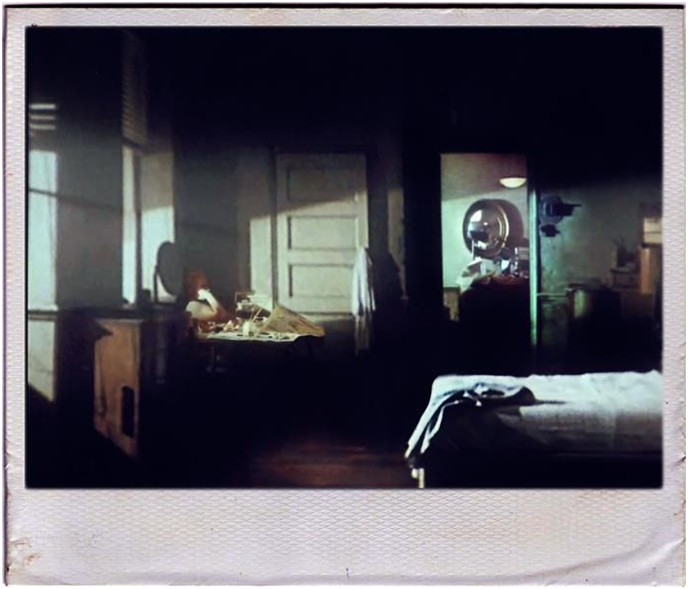
In the scene, Deckard is in the darkness of his messy flat, the machine set up with several screens not unlike a modern film editing suite. He has just upset Rachel (Sean Young) by making her realise that she is a replicant; the Polaroid she has of her when she was younger rendered heartbreakingly meaningless as her impression of it was merely an implant.
Seeing the photograph reminds Deckard of the pile of photos he collected earlier from the replicants’ apartment. The machine scans the images and reproduces them on several screens. With the photograph that has caught his eye uploaded, he starts to explore it on screen.
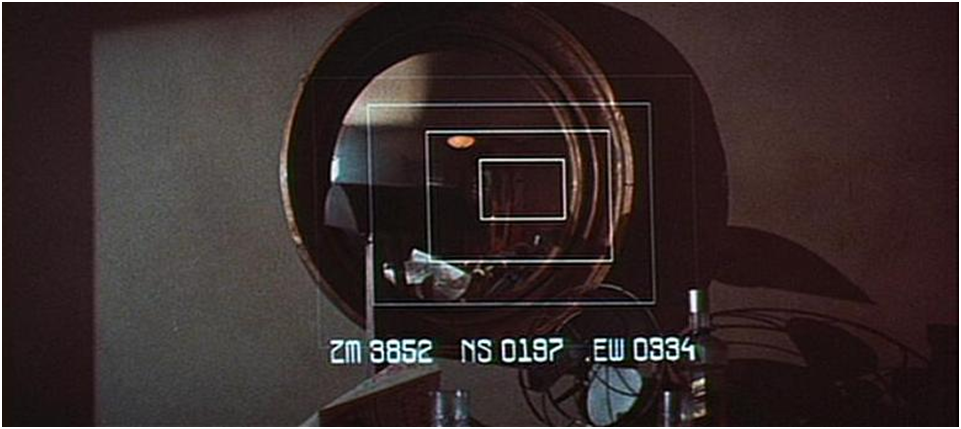
At first he zooms further into the space of the image, wandering through the room with the clicks of the machine measuring his journey, sometimes printing out new magnified versions just like Thomas did in his Holland Park studio. The machine seems more of an elaborate magnifying glass, a typical trope of the sort of detective fiction the film bounces off.
The machine clicks, tracking the space he is travelling like mechanical footsteps. It would not be too unexpected for Deckard to spread his thumb and forefinger upon the glass of the screen to heighten the zoom just like on the touch-screen of a phone or tablet today. But something subtle and strange happens as the image zooms further. Soon, we are not fully in the room that the photo is of but approaching the room beyond, seen only through a gap in the doorway at the back of the photo.
There is a mirror on the wall of this other room, partly out of view. Yet the machine allows him to view this mirror’s reflection in detail, even if he cannot turn around and see the person behind the door. This is where my eyes, my own organic Esper Machine, are superior to Deckard’s technology. They can see around the walls of Polaroid photographs because my imagination is inexhaustive and space is insinuated with greater strength within them.
He travels into the mirror and we see its reflection showing one of the replicants sitting in the bath. It is the one he is closest to finding, realising what the fragment of skin he found was; a tattoo on the replicant’s neck showing a snake. Though the machine does not work further than the world of reflections within the image, the roaming is surreal. I, too, wander into such reflections, sometimes zoning in on particular spaces and wondering what is just around the corner.
Perhaps I become the ghost of their analogue reality, haunting their spaces on a plain beyond the perception of their world, leaving for a time this digital purgatory of ours. If ghosts exist there, I wonder whether they are merely the viewers of Polaroids in other worlds beyond our own; ours being the imperfect reflection.
Soft light through drawn curtains; is my shadow cast on their walls?
Rooms of a building I have never been in seem more corporeal in those moments than my own body, their design insinuated in unusual detail. Perhaps the strict frame of a Polaroid highlights the lines within the photos more powerfully but space certainly feels more tangible and defined. It matters little whether there are discrepancies between reality and the images brought to mind by a Polaroid. The photos will always be coloured by this third world, whether accurate or not.
This may just be a roundabout way of suggesting that Polaroids fire the imagination with unusual vivaciousness. Yet, with the photo having been there, there is a sense of something else. Perhaps the word I am looking for is trust, and that trust is a strangely spatial one: I believe in their spaces because of their presence.
In a world where people can be replicated and reality itself seems choked with images, I find it poignant that, even in the far future of last year, the inhabitants of Los Angeles still found something worthwhile in Polaroid photographs and physical photographs in general.
In the damp, crowded and claustrophobic city presented in the film, it is unsurprising that Polaroids carry some weight, even if the two main characters we experience that desire through turn out to be androids. Of course androids find solace in instant memories.
The scenario comes full circle and back to reality thanks to Blade Runner. It is often the way that, when drifting into lucid daydreams and blurring between grey fact and dazzling fiction, that the justification I find myself clawing for when living in this bizarre half-step with reality comes to me by a certain quirk of fate.
For a film that has a character seeking a past of sorts in Polaroids, it is apt for Polaroid photographs of behind-the-scenes of the film to exist alongside the fictional ones. In the most replicant of ways, the memory of these times and places was ordained as being best documented with Polaroids.
During the production, Sean Young who plays Rachael – a woman who Deckard falls in love with only to find that she is a replicant and unaware of it, her evidence ironically being counterfeit memories given authenticity by a Polaroid – took a variety of Polaroids of the cast and crew as they made the film. Because they were taken on Young’s camera, she is the subject in most of them, though not always the photographer. Sometimes the photos are merely just a document of her time working with the crew. Others are more interesting.
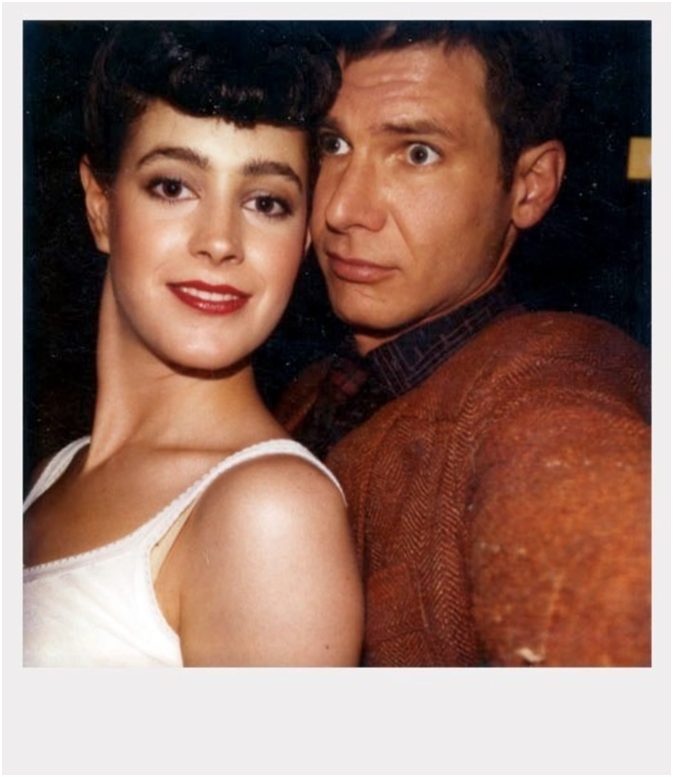
This Polaroid, for example, is enjoyably absurd in the context of the film. Harrison Ford is still in his Deckard costume, while Young is seemingly between takes. Both are wearing an expression far from their moody characters of the film. Ford in particular seems to be holding the camera in such a way as to technically render it a selfie. And yet, what is the space they are really inhabiting, the filmic or the real?
If I were to take an Esper Machine and scan this photo into it, would the space be that of a film set or something else? Would I click my way into Los Angeles in 2019 or 1981? Both are now unnervingly in the past.
Either way, space feels contained within this image, heightened further by the fact that everything about the composition of the photograph is augmented by the realities of that space. We get a sense of distance between camera and subject because we can roughly see where it begins (Ford holding of the camera) and what the light first meets (their bodies). But the space continues nevertheless.
Photography in Blade Runner speaks of space because photos seem to actually contain it. Even in these quite simple photographs, a sense of space is there. I want to put my hand through and feel it. When I see them, my mind activates its own Esper Machine, clicking closer and closer into detail until I move out of the frame, imagining the cast and crew during the production of the film, or perhaps Los Angeles in 2019 with its flying cars and mechanical owls.
I fail to distinguish between the real world and the fictional one, perhaps undermining my readings of the photographs but also explaining the joy they bring me, which is ultimately more important. Their space is ambiguous as their world is not straightforward to my eyes. I cannot see their contradictions because already, perhaps as an escape, I am taken away from my own moment when I look at them.
Polaroids transport us because they insinuate the space of worlds beyond. I fragment and reform within them. I am simply not here when I look at them. They are the quiet suicide of my passing existence. I exchange the gift of their presence with my whole being, just for a short while.
Whenever my mind is raw with thoughts turning over and over, I can leave this space, riddled with troubles, and enter a Polaroid. Beyond the frame, space resides, in the same way that beyond me the world resides. Whatever reality is there, even just over the shoulders of the subjects such as an actor or a Blade Runner, my mind travels with ceaseless ambition.
The horror of internalising everything and never letting it escape – my own silences, of which I never find the right person to help break – dissipates as I explore spaces beyond my experience, cracking the locks imposed by my own skull, that frustratingly effective bony cage.
In one scene in the film, a floating advert shouts about the opportunities to leave 2019 Los Angeles, famously sloganeering ‘A new life awaits you in the off-world colonies; a chance to begin again in a golden land of opportunity and adventure.’ It may only be momentary, but Polaroids offer this in abundance as I step through their grain and into their spaces, away from this world.
…
Polaroids contain space, map it and change our perception of it. Whether in parks littered with corpses, houses of writers with car crash fetishes, empty American highways devoid of hope or the precious mementos of androids, Polaroids show that space within photographs is complex.
When I take a Polaroid, I am memorialising my space in that moment for a future occasion. When I look at a Polaroid taken by another photographer, I feel privileged to be able to wander within those spaces that they experienced and visited; whether contained within its own unique style of imagery or genuinely evidenced and accrued through the journey on which it has been travelling since it first exited the camera.
The Polaroid is a nomadic object that soaks up the spaces it is in the unique position to witness.
Space sits within its grain.
This is something the British artist David Hockney understood. In fact, he understood it with such clarity that he created huge Polaroid collages, mapping the real space of Los Angeles swimming pools in the early 1980s, using the square of the image as a fragmentary form of cartography. He eventually took to using such a technique upon people as the subject but the spatial works are more effective as they understand the form’s relationship to documenting places.
‘It worked so well that I couldn’t believe what was happening when I looked at it,’ Hockney suggested. ‘I saw all these different spaces and I thought: “My God! I’ve never seen anything like this in photography.”’ He could not have sounded more excited, exploring the possibilities of the camera with the energy of an addiction, later describing the endeavour as an attempt to realise Cubist ideas through the photographic medium.

In exploring space and Polaroids, my mind wanders with equal relish. An idea explored in a passage of the novel Camera (1991) by Jean-Philippe Toussaint comes to mind. It captures the sense of the gaze we all carry and how it is of a photographic nature. His description has decidedly more in common with Polaroid photography than other forms.
… if I had kept the camera, I would have been able to take some pictures of the sky as it is now… And, continuing to stare at the sky, I realized now that I had taken this photo on the boat, that I had suddenly and successfully extracted it from me and from the moment, running up the boat’s stairs in the night, practically unaware of being in the process of taking photos and yet ridding myself of this photo I had so long yearned for; I immediately understood that I had seized in the fleeting intensity of life, though it be inextricably buried in the inaccessible depths of my being. It was like a photo of the feverish impetus that I carried in me, and yet it already testified to the impossibility that would follow, to the disaster that it would create. For I would be seen fleeing in the photo, I would be fleeing as fast as I could, my feet leaping from steps, my moving legs flying over metal gaps between the boat steps, the photo would be blurry but still, the movement would be frozen, nothing would move, not my presence nor my absence, there would be the whole stretch of stillness that precedes life and that that follows it, hardly more distant than the sky onto which I was looking.
Many photographers thankfully did have a camera on them, and did capture their own spaces and movements, delivering the resulting contradiction: the stillness of images on the move.
The American photographer Stephen Shore once described Walker Evans’ photos as ‘closed little worlds’ though it is virtually impossible to apply this description to a Polaroid, especially those taken by Evans. Space is held within a Polaroid – suggesting the world around it to the right eye – and accrued in its natural journeying once spat out of the camera, blinking in the harsh light of the moment. It feels far and away from being closed. In fact, it barely feels able contain its subject.
Far from closed, these worlds are porous; constantly changing, ageing and developing.
‘We have seen that the instantaneous tends to make meaning ambiguous,’ wrote John Berger, ‘but the cross-section, if it is wide enough, and can be studied at leisure, allows us to see the interconnectedness and related coexistence of events.’ This acknowledgement is heightened in a Polaroid, not least because events co-exist with the very creation of the image. We know that other things happen, and so the Polaroid suggests life beyond the frame; perhaps because it was held by others whose lives and experiences are beyond our own.
The object was a part of all of those lives, all of those worlds.
 Celluloid Wicker Man
2 thoughts on “Presence, or Polaroid Ghosts (Part 7)”