
Marguerite Duras was never keen on giving cinema an easy time. Adapting her own stories into feature films, it seems that the writer, rather than compromise the unusual qualities of her books, experimented and destabilised the narrative aspects of film form to suit her needs instead.
Like her contemporary, Alain Robbe-Grillet, Duras made many attempts to transplant the elements of voice from her literary work into film, usually involving one specific technique: the detaching of the narrative elements of voice from the body of the performers. Much has been written of the disembodied voice, especially in audio-visual theory that focuses heavily on the surreal presence of voice-over dialogue in popular cinema (with particular interest in film noir), but Duras’ striving to make the form fit her own narrative style often meant that her work defied some of the more conventional sound hierarchy theories. Filmmakers rarely, if ever, conform neatly to the theories of closeted academics.
When first watching her brilliant 1975 feature India Song, a sense of the uncanny was present from the very start. It was only some way into the film that it became clear as to why this was; that the voices we hear the characters communicate with are in the soundtrack rather than diegetically there. We do not see them speak.
The narrative is opaque and, rather like Robbe-Grillet’s Last Year in Marienbad, it follows a group of interconnected characters wandering through a large mansion, almost dreaming each other into existence. Actors such as Delphine Seyrig and Michel Lonsdale look on at each other, seeming to act the meaning of their dialogue but never opening their mouths to speak it. There could be several reasons for this but the decision seems part of Duras’ overall experimentation with the voice-to-narrative relationship. The overriding feeling in India Song, even with the luscious costumes and splendour, is that the film’s visual is dramatically within the past tense; that we are watching ghosts looking back; the glamorous dead reliving their favourite local haunt.
Duras’ smaller scale films use similar techniques; in particular disrupting the sense of place by making it seem out of sync. In many of her shorter films, the voice is again disembodied but even less attached to any ownership of the narrative.
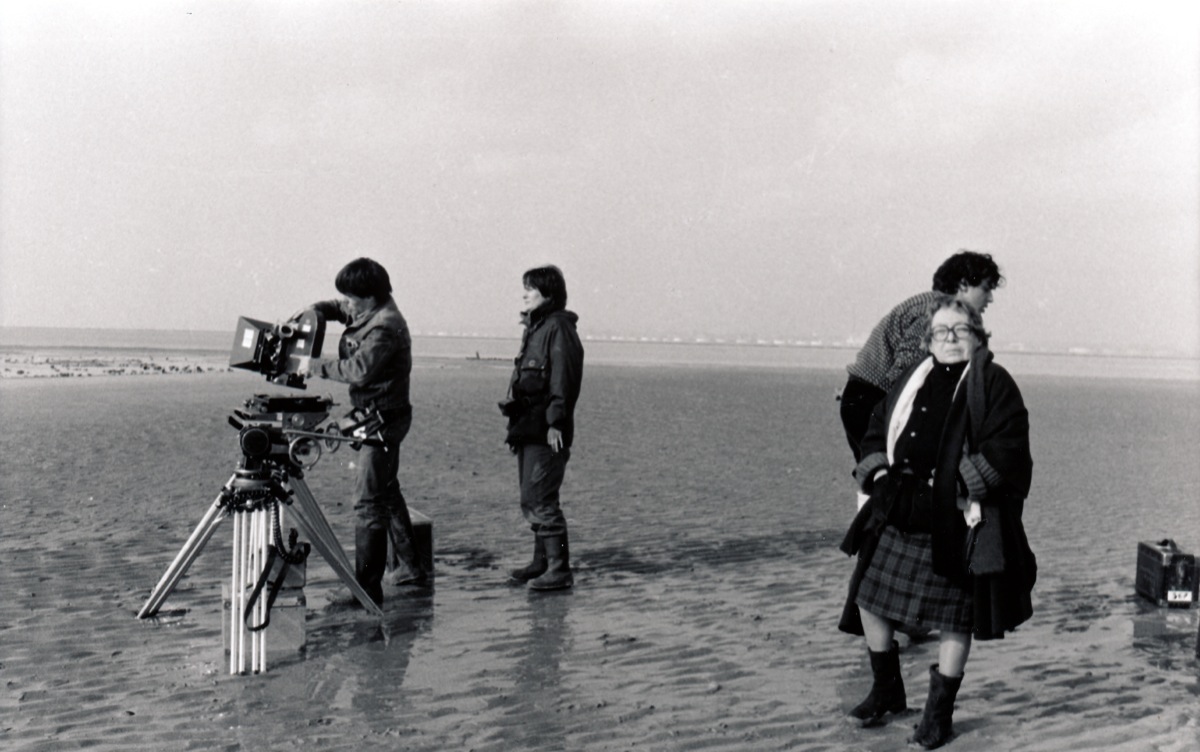
In her 1981 film Agatha and the Limitless Reading, a similar scenario to India Song is played out in the desolate seaside resort of Trouville. The rupture is even more exaggerated, perhaps to highlight the film’s role as an essay, with cameras being seen in mirrors and with actors (including Bulle Olgier) improvising their way physically around the large rooms and wintery beachscapes.
The fact that the narrative is addressing childhood memories, including an incestuous relationship, perhaps begins to explain why this technique, a distancing effect, is opted for by Duras. The traumas – sexual, colonial, and emotional – are almost too dramatic to face head on and would be rendered melodramatic by their strict recreation. Duras slips the characters into the past, the present always off screen but echoing through the soundtrack.
The same seaside resort can be found in a number of her films though not always using the same technique. The ensemble drama Woman of the Ganges (1974) uses the same set-up but keeps the dialogue and the visual attached, creating a lesser effect and film. The disjoint is, however, retained for the short film L’homme Atlantique (1981), made at the same time as Agatha.
The main character’s voice is lost entirely and given over to Duras’ instead. The disjoint frames the film even further as an essay; her writing style has often found drama in essayistic styles of writing, and the same rings true for her films.
In Agatha in particular, the questioning begins to highlight the very process of the filmmaking, almost as if Duras is satirising cinema or at the least questioning its legitimacy for dealing with personal, dramatic issues (the same issue that Michael Haneke has been dealing with for most of his career). The fact that this technique is adhered to, in spite of using some of the most famous of French performers working then, shows how important this questioning is for Duras. Even France’s most celebrated stars cannot connect their voice to their lips when Duras was behind the camera.
Perhaps most interestingly, the form breaks down in a film where the voice is retained. In La Camion (1977), the structure, while having the voice disembodied throughout several shots of a lorry on a journey, is grounded by Duras herself reading and discussing the script for the film with Gérard Depardieu. Even if the disjoint is, on a visual level, lesser in this case because the sound can always be reframed back to the setting of the drawing room where the reading takes place, the film is the most temporally fluctuating of Duras’ features. The lorry’s journey feels to be through time as much as space.
The disjoint instead comes from inverting of the filmic process, amalgamating a practical element of the film’s production (the script reading) into the very narrative itself. More so than simply allowing a camera to be shown in the reflection of a mirror, Duras breaks apart the whole of the cinematic process, à la Jean-Luc Godard, albeit more casually, allowing access to the emotional resonances of the work but through an open break that speaks of an unusual level of trust in the viewer.
 Celluloid Wicker Man