
Scenes from a Marriage was Ingmar Bergman’s first successful attempt to work in the medium of serialised television. The six episode series following the highs and lows of a marriage signposted many changes that the director would make during his work in the 1970s, aesthetically and thematically.
Though a later cut of the series’ six episodes was edited into as a whole film for American audiences, several unfortunate changes to the drama were made in order to accommodate its new running length. This is not a list of the many changes and the negative impact of losing many of those elements has, but it is instead an exploration into one particular aspect lost in the edit; an aspect that I believe to be vital in structuring the emotional relationship of Bergman’s drama.
Bergman’s drama follows the turmoil and emotional complexity of a marriage in gradual disarray. A full decade’s worth of scenes are shown from the matrimonial pairing of Marianne (Liv Ullmann) and Johan (Erland Josephson) as they continue to meet on and off for various reasons after an affair leads to a messy separation. While much of the drama remains largely intact in the film edit, it loses a key motif: a structural, landscape-infused pillar from the television original found in each episode’s end credits.
At first, losing the credits of a television show may not seem too important to the overall drama. Yet, it is what Bergman actually did with them that makes their loss undermine the film edition, to the point where the film resembles little more than a curio.
At the end of each episode, the credits do not appear in full but are read by Bergman himself. He lists the performers and the technical staff, the name of the episode, the production and its filming location on the island of Fårö. Already, this can be seen as an unusual practice, especially because Bergman’s does not announce his own involvement.
More importantly, however, are the images which accompany this reading of the titles. Bergman does not have himself filmed for his credit reading, nor is it something theatrical akin to Orson Welles’ occasional reading of the main players (particularly in what remains of The Magnificent Ambersons). Instead, all six episodes of the series end with specific footage of the landscape of Fårö, with Bergman even inviting the viewers to look upon such images as he reads the credit names.
Like in so many of his films, the landscape of his island home plays an important role. All of this is lost in the film version and the narrative, often moving between claustrophobic spaces where great emotional trauma and turmoil, is allowed to freely and chaotically flow with little context as to the gaps of time between the chapters. These little landscape postcards seem a vital cleanser, in particular in the darker episodes.
In the first episode, titled Innocence and Panic, the viewer is shown Marianne and Johan being interviewed by a lifestyle magazine on their tenth anniversary. The journalist wants to know what makes a successful marriage and her questions dislodge some of the problems that are clearly embedded in the relationship. They are later witness to their friends’ bickering which turns poisonous, showing the married couple what a supposed bad relationship looks like. It appears to be a different world to theirs, but really it is just a foreshadowing of what is to come.
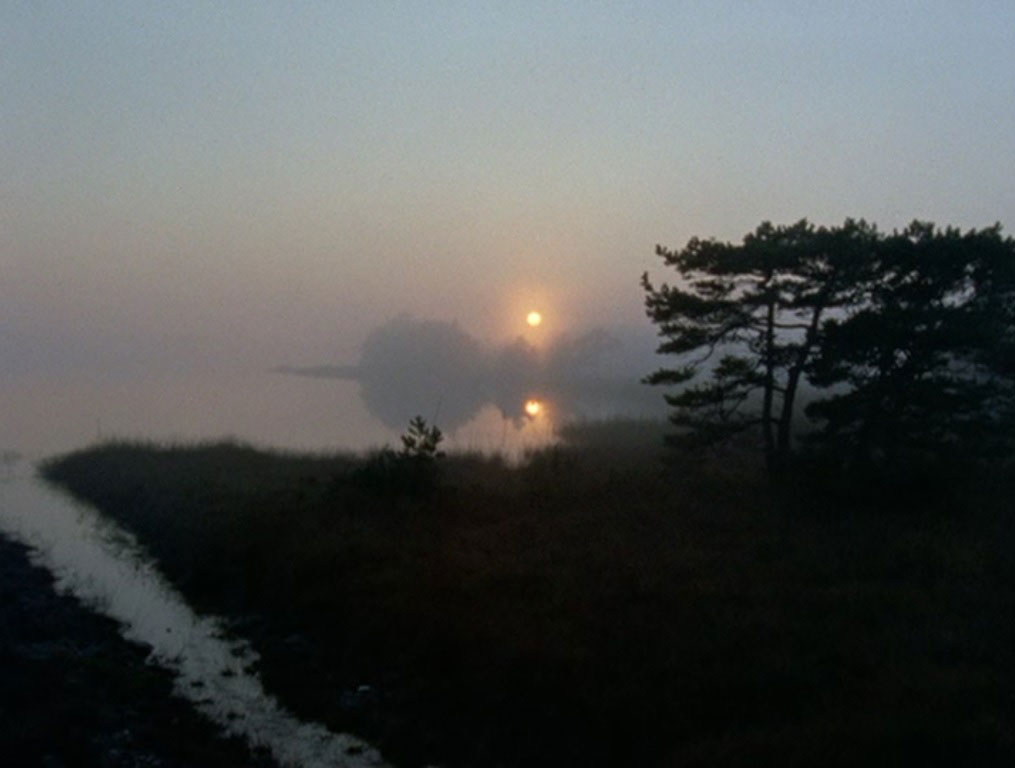
To end this episode, Bergman opts for a zoom shot of the Fårö landscape at sunset. This is one of three landscape shots that involve some sort of zoom out and it seems an important editing tool. Here, and in the next episode, the track back over the landscape allows the perspective of the initial focus of the shot to slowly come into view. The first two episodes of the drama itself do the same thing for the pair’s relationship (to more chaotic effects). This also features in the last episode, after everything has happened and the decade that has taken up the series is itself put into focus.
The first landscape shot shows a sun setting; the landscape approaching dusk. There is a gentle fog enveloping the ground. The reflection of the sunlight in the water could easily be read as highlighting the reflection that the pair have been witness to in the failings of their friends’ marriage (that of Katrina and Peter played by Bibi Andersson and Jan Malmsjö).
It is a gentle moment but one that suggests the sun to be setting upon the marriage as a smooth-running arrangement (and one which further builds as the landscape shots are clearly in some sort of chronological order).
The second landscape is the same as the first but further in land. The episode, The Art of Sweeping Things Under the Rug, sees Marianne question herself as she succumbs to the domineering presence of parents. The credits begin with a close-up of a frost-covered stone which zooms out to reveal a wall in the landscape that was hidden from the first set of credits. The wall separates the two characters; one increasingly fragile, the other confident enough to flirt with a co-worker at the university.
Similar visual themes build as the marriage disintegrates. In the next episode, Paula, Johan’s affair is revealed (along with the fact that he is leaving his wife and their children to go and live with his mistress). The landscape shown is clearly at night but now removed to a beach where a lonely, rusted boat sits upon the shore while a pathetic lighthouse fails to give proper light to signal danger. These two objects paired together reflect the state of Marianne who had no warning as to the intentions of her husband when he walked into their holiday cottage that night. Marianne had no warning light and crashed violently against the shoreline, left to rust and decay alone.
Other themes seem even more literal though less effective. For example, in the episode, The Vale of Tears, the credits reflect the title by being a very simple close-up of rain falling upon water while the following episode’s climactic violent encounter emphasises a dead tree after the pair have eventually agreed to sign the divorce papers. Again both shots are static and reflect the lack of emotional progress apparent when the two characters are in each other’s company. If anything, things are falling backwards.
The final episode shows the ironic pairing of the two characters far after they have both remarried. In “In The Middle of the Night in a Dark House Somewhere in the World”, they decide to spend the night together for what would have been their twentieth anniversary and end up at a friend’s lodge. Marianne has a nightmare and wakes up, with Johan comforting her.
In some ways, it seems that the last five episodes could have been playing over in the character’s dreams. The landscape in the final episode shows an ambiguous time-frame (it could be dawn or dusk) and in this sense, it reflects the unavoidable ambiguity of their relationship’s future: is it really over or is it always to be as habitual as a sunrise or sunset?
Bergman gives the viewer one more landscape shot, showing two separate houses reflected in the water. The sun hovers between the two with a gentle gleam. A huge lake ripples out, creating an almost indivisible sense of landscape meeting water meeting sky. The sun could be rising or it could be falling but, either way, the characters are left with only the landscape for comfort; strong with indifference and brutally reflective in its terrain.

 Celluloid Wicker Man