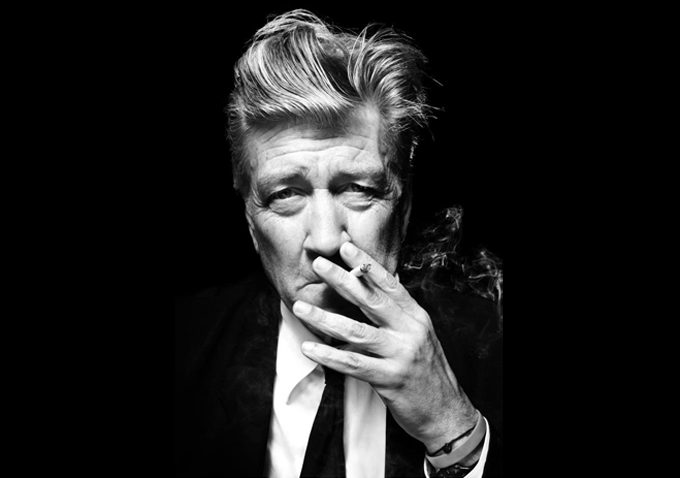
David Lynch’s Musical Formations of Cinematic Ideas (The Big Dream).

David Lynch has a very clear and obvious interest in music. This interest finds its way into his films via a number of different methods and often build upon the director’s main recurring themes and ideas. What makes David Lynch distinct from other American directors with interests in music such as Martin Scorsese and Woody Allen is that Lynch’s interest has peaked at a point … Continue reading David Lynch’s Musical Formations of Cinematic Ideas (The Big Dream).


Distant Voices, Still Lives (Part 3) – Music, Memory and Society.

Part 1. Part 2. Part 3. Part 4. Part 5. Part 6. Music, Memory and Society. Adorno and Eisler argue that: “As a matter of principle, priority goes to the truly novel musical resources. However, motion-picture music can also summon other musical resources of the most varied nature, on the condition that it reaches the most advanced contemporary modes of composing, which are characterized by … Continue reading Distant Voices, Still Lives (Part 3) – Music, Memory and Society.

Antichrist (Lars von Trier) and Handel’s Aria (Lascia ch’io pianga)

Lars von Trier’s recent film work often uses very specific musical cues within its narrative framework.  His visual style has developed very clearly beyond his self-imposed Dogma ’95 rulings, and his sound world also reflects this almost seismic change. Though music is equally as imposing in his 2011 Melancholia, the music used in his controversial 2009 film, Antichrist, sums up this sparse but very specific musical … Continue reading Antichrist (Lars von Trier) and Handel’s Aria (Lascia ch’io pianga)